
Best Chocolate Dipping Tool Sets for Homemade Treats: 7 Research-Based Picks for Truffles, Strawberries, and Cake Pops
Comparing the best chocolate dipping tool sets for homemade treats — spiral dippers, 2- and 3-prong forks, cradling spoons, and multi-piece kits, ranked by material, grip, cleaning, and value.
Quick Comparison Table
| Image | Product | Key Feature | Buy Now |
|---|---|---|---|
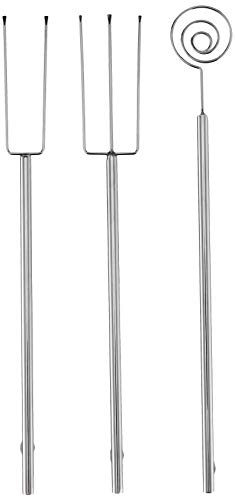
| Ateco 1378 Dipping Tool 3-Piece Set 🏆 Best Overall | Three head designs in one set: Covers spirals for round centers, two tines for flat items, and three tines for soft or awkward shapes, so you are not switching tools mid-batch. | Buy Now | |
| Ateco Spiral Dipping Tool, Large 🏆 Best for Round Truffles | Coil-style cradle: The treat sits on the wide part of the spiral, which supports a round center from underneath rather than piercing it. | Buy Now | |
| Patelai 12 Pcs Candy Dipping Tools, Chocolate Dipping Forks Spoons Set 💰 Best Budget Multi-Pack | Twelve pieces in one purchase: Lowers the effective cost per tool and removes mid-batch washing bottlenecks. | Buy Now | |
| 6 Chocolate Dipping Fork Tools + 2 Culinary Drawing Decorating Spoon Set 🏆 Best for Decorating | Six dipping forks: Plenty of handling capacity for a full tray, plus spares if a tine gets bent. | Buy Now | |
| Wilton Candy Melts Candy Dipping Tool Set, 3-Piece 👌 Best for Beginners | Cradling spoon: Supports awkward or heavy treats — big strawberries, loaded cake pops — from below rather than piercing them. | Buy Now | |
| Marsrut Perfect DIY Dipping Chocolate Tool Set 💰 Best Budget Pick | Spiral head for round centers: Coats pralines and truffles from underneath, the same principle as pricier spiral wands. | Buy Now | |
| 3Pcs Chocolate Dipping Tools, Stainless Steel Truffle Candy Dipping Tools Set 📐 Best Compact Set | Three stainless pieces: Covers the core dipping motions without a large storage commitment. | Buy Now |


Tested & Recommended Amazon Products
Research-based comparisons • No hands-on testing
Spiral dippers, two-prong and three-prong forks, cradling spoons, and multi-piece kits — compared by material, grip, treat shape, cleaning, and value.
🌟 Key Features That Stand Out
- ✓ Three head designs in one set: Covers spirals for round centers, two tines for flat items, and three tines for soft or awkward shapes, so you are not switching tools mid-batch.
- ✓ Rust-resistant stainless steel build: The material specification is published by the commercial retailer listing and supports repeated use with hot coatings.
- ✓ Weighted metal handles: Multiple buyers on the supplier's review section describe the hand feel as substantial and "heavy duty," which helps keep the wrist steady on a full tray.
- ✓ Thin-gauge wire heads: A reviewer notes the wire is thin enough to avoid leaving heavy marks in the coating while still supporting generous pieces of fruit.
- ✓ Long handles: The longer shaft keeps fingers away from the rim of a warm bowl and works for deep fondue pots as well as shallow melting bowls.
- ✓ Dual-purpose pointed tool: One reviewer uses the pointed piece as a scribe to pop air bubbles out of a mixture, an unintended but practical second job.
- ✓ Multi-coating friendly: A reviewer recommends buying more than one set so savory or allergen-containing coatings stay separated from chocolate batches.
💡 Why We Recommend It
🎯 Best For
✅ Pros
- Genuinely different head geometries — spiral, two-prong, three-prong — rather than three versions of one fork.
- Stainless steel construction with rust resistance stated on the commercial retailer listing.
- Substantial, weighted hand feel that reviewers describe as heavy duty and durable.
- Thin wire heads minimize drag marks compared with spoons or skewers.
- Long handles keep hands clear of hot bowls and work in deep fondue pots.
- Also serviceable for caramel and cheese fondue, per buyer reports.
❌ Cons
- Heavier handles than plastic sets — reviewers say this takes adjustment.
- One reviewer finds the handle profile on the slim side.
- Dishwasher use is reported to encourage rust on the thin stainless parts; hand washing is safer.
- Sold as a set only, so you cannot swap in a single tool you actually use most.
🌟 Key Features That Stand Out
- ✓ Coil-style cradle: The treat sits on the wide part of the spiral, which supports a round center from underneath rather than piercing it.
- ✓ Underside coating coverage: The Kitchn describes the tight spiral as letting chocolate coat the ball from below, an area a flat fork cannot reach cleanly.
- ✓ Natural drip-off: Excess coating drains over the bowl as you lift the tool, which reduces pooling on the parchment.
- ✓ Decorative spiral imprint: Inverting the dipped treat onto parchment and pressing lightly leaves a small spiral design in the shell.
- ✓ Stainless steel body: Heat-tolerant and easy to wipe clean between coatings.
- ✓ Single-tool simplicity: No set to store — it slides into a utensil drawer beside a fork.
- ✓ Size options within the line: Small spirals suit nuts, cherries, and petit fours; the large head suits strawberries and golf-ball-size cake balls.
💡 Why We Recommend It
🎯 Best For
✅ Pros
- Cradles round centers from underneath, so soft ganache does not collapse during dipping.
- Coats the underside of the treat, where flat forks typically leave a bald spot.
- Lets excess chocolate drip back over the bowl for a cleaner, thinner shell.
- Leaves a distinctive spiral imprint that doubles as an artisan finish.
- Stainless steel wipes clean easily between white and dark chocolate batches.
- Takes up almost no storage space compared with a full set.
❌ Cons
- Does nothing useful for flat treats: caramels, crackers, pretzels, and bark need a fork.
- A single specialty tool can be a large share of the cost of a full three-piece set.
- Coil must be dried fully and kept reasonably clean inside the coil, which takes a few extra seconds.
🌟 Key Features That Stand Out
- ✓ Twelve pieces in one purchase: Lowers the effective cost per tool and removes mid-batch washing bottlenecks.
- ✓ Forks and spoons together: Covers delicate round items and broader cluster-style treats in the same kit.
- ✓ Stainless steel construction: The listing category and title specify stainless, which is the material that resists bending in hot coating.
- ✓ Separate tools per coating: Assign one or two tools to each chocolate color to avoid streaking a milk chocolate batch with dark residue.
- ✓ Great for shared kitchens: Enough pieces for two or three people to dip side by side at a party or bake sale prep session.
- ✓ Replaceable units: With a dozen pieces, losing or bending one does not end your candy-making session.
💡 Why We Recommend It
🎯 Best For
✅ Pros
- Twelve stainless pieces means far lower cost per tool than single-name-brand dippers.
- Forks and spoons together handle both delicate round items and wet cluster-style treats.
- Separate tools per chocolate color prevents cross-contamination between coatings.
- Enables two or three people to dip simultaneously during large sessions.
- Spare pieces absorb loss and bending without interrupting a batch.
❌ Cons
- Bulk-pack construction is lighter and less refined than a commercial-brand single set.
- Twelve pieces take up considerably more drawer or crock space.
- Thin utensils can deform if stored loosely or used to pry frozen items apart.
🌟 Key Features That Stand Out
- ✓ Six dipping forks: Plenty of handling capacity for a full tray, plus spares if a tine gets bent.
- ✓ Two culinary drawing spoons: Fine-tipped spoons for drizzling stripes, writing messages, and drawing feathers or swirls on set chocolate.
- ✓ Two-stage workflow in one kit: Coat with a fork, then decorate with a spoon without hunting for a piping bag.
- ✓ Stainless steel bodies: Wipe clean quickly when switching between white and dark chocolate for contrast drizzle.
- ✓ Decorating without a piping bag: A drawing spoon is faster to set up than a filled bag for a few decorative lines.
- ✓ Useful beyond chocolate: The drawing spoons work for caramel, icing, ganache plating, and sauce dots on dessert plates.
💡 Why We Recommend It
🎯 Best For
✅ Pros
- Covers coating and decorating in a single purchase instead of two separate orders.
- Drawing spoons make drizzles, swirls, and initials far easier than a dipped fork.
- Six forks give you capacity for a full tray plus spares.
- Stainless steel wipes clean between contrasting chocolate colors.
- Decorating spoons double as plating tools for ganache and sauces.
❌ Cons
- No manufacturer brand is stated, so warranty and support documentation are limited.
- Fork head width and handle length are Not verified in the listing description.
- Decorating spoons are unnecessary if you only coat and never drizzle.
🌟 Key Features That Stand Out
- ✓ Cradling spoon: Supports awkward or heavy treats — big strawberries, loaded cake pops — from below rather than piercing them.
- ✓ Three-prong fork: Spreads support across a wider area, which helps with cake pops and marshmallows.
- ✓ Spear: Drives into firm centers such as marshmallows and cake balls where a fork would tear the surface.
- ✓ Manufacturer-stated care instructions: Wilton documents washing in warm soapy water before first use and after each use, which simplifies ownership.
- ✓ Designed for candy wafers: Matched to the melting-wafer workflow, where coating is thicker and more forgiving than tempered couverture.
- ✓ Small, light, and easy to store: Three short tools fit in a drawer organizer with minimal footprint.
💡 Why We Recommend It
🎯 Best For
✅ Pros
- Clearly defined roles for each of the three tools, ideal for first-time candy makers.
- Cradling spoon holds large strawberries and loaded cake pops securely.
- Spear is the right tool for marshmallows and cake balls, where forks tear the surface.
- Manufacturer publishes washing instructions, removing guesswork about care.
- Lightweight handles are easy on the wrist and gentle on nonstick bowls.
- Compact footprint — three short tools store easily in a small kitchen.
❌ Cons
- Plastic-and-metal construction is less heat-resilient than all-stainless tools.
- Optimized for candy melts rather than tempered couverture chocolate.
- Only three pieces, with no spiral dipper for round truffle centers.
🌟 Key Features That Stand Out
- ✓ Spiral head for round centers: Coats pralines and truffles from underneath, the same principle as pricier spiral wands.
- ✓ Stainless steel body: Heat-tolerant and simple to wipe down between batches.
- ✓ Minimal financial risk: The low entry point lets you trial the spiral technique before buying a set.
- ✓ Drawer-friendly storage: One slim tool that disappears into the utensil drawer.
- ✓ Good second tool: A sensible backup spiral if your main one is already loaded with white chocolate.
- ✓ Works for savory and sweet dipping: A plain stainless coil also handles fondue-style dunking.
💡 Why We Recommend It
🎯 Best For
✅ Pros
- Lowest cost of entry for testing the spiral dipping technique.
- Stainless steel head wipes clean and tolerates hot coating.
- Coats round centers from the underside, where flat forks miss.
- Tiny storage footprint with almost no drawer disruption.
- Useful as a dedicated second spiral for a contrasting chocolate color.
❌ Cons
- Coil diameter and handle length are Not verified, so sizing is a guess.
- Single tool handles one treat shape only — no forks for flat items.
- Brand documentation and warranty support are minimal.
🌟 Key Features That Stand Out
- ✓ Three stainless pieces: Covers the core dipping motions without a large storage commitment.
- ✓ Listing states dishwasher safe: Easier cleanup for cooks who prefer not to hand dry thin-gauge tools.
- ✓ Truffle and candy focus: Positioned specifically for truffle and candy dipping rather than general kitchen pickup work.
- ✓ Fondue fork included: Useful for caramel, cheese, and chocolate fondue beyond candy production.
- ✓ Home-baker sizing: Aimed at household quantities rather than commercial volumes.
- ✓ Simple all-metal construction: No plastic handles to crack or loosen over time.
💡 Why We Recommend It
🎯 Best For
✅ Pros
- Three-piece coverage with minimal storage footprint.
- Listing states dishwasher-safe care, which simplifies cleanup.
- All-metal construction with no plastic handles to degrade.
- Fondue fork extends usefulness to caramel and cheese dipping.
- Inexpensive enough to keep as a dedicated candy-making set.
❌ Cons
- Head geometries are not described in the listing, so tool types are unconfirmed.
- Three pieces is not enough to avoid washing mid-session on large batches.
- No brand documentation or warranty support stated.
🏆 Our Top Pick
How to Choose the Best Chocolate Dipping Tool Set
Six criteria actually change which tool set you should buy: head geometry, material, handle length, piece count, care requirements, and the coating you use. Everything else is preference.
Match the Tool Head to the Shape of the Treat
This is the single most important decision. A spiral coil cradles round centers and coats their undersides, per The Kitchn's explanation of how a spiral dipper works: the treat rests on the wide part of the coil, gets lowered into melted chocolate, and leaves a small spiral imprint when inverted onto parchment. A two-prong fork is for items with one flat face — square caramels, crackers, cookies, and pretzel rods — because two tines support a flat plane without splitting it. A three-prong fork spreads weight across more surface area, making it easier to nudge soft pieces around the bowl. Cradling spoons handle heavy, awkward items like large strawberries, and a spear drives into firm centers such as marshmallows. If you buy one tool, buy the one that matches your most frequent recipe. If you buy a set, verify that the listing names each head type.
Material: Stainless Steel vs. Plastic-and-Metal
Stainless steel tools hold their shape in hot coating, resist bending under a loaded strawberry, and are what commercial baking suppliers stock. Wilton's set is described by the manufacturer as plastic and metal, with a published declaration of the stainless components it contains — that build is lighter, gentler on coated bowls, and perfectly adequate for melting-wafer projects. The trade is heat resilience and long-term rigidity: plastic handles can loosen over years of dishwasher cycles, while all-stainless tools are heavier in the hand. If you temper real chocolate and dip frequently, stainless is the better long-term buy.
Handle Length and Grip
Longer handles keep your fingers away from a warm bowl and work in deep fondue pots. Reviewers on the Ateco 1378 set specifically credit the long handles for sturdiness, while others flag that the handles feel heavier and one describes the profile as somewhat slim. There is no universal right answer — test your own hand position by imagining holding a pencil versus a serving spoon. Thin-wristed tools are more maneuverable over a shallow bowl; thicker handles are steadier over a deep pot.
Piece Count and Workflow
Two tools cover most recipes. A third helps when you run multiple coatings, and eight to twelve pieces eliminate the washing bottleneck entirely during a long session. Extra pieces also let you dedicate a tool to allergen-free coating to prevent cross-contact, which reviewers of commercial sets explicitly recommend. If you dip with family or friends, a multi-pack is a functional upgrade, not just excess.
Cleaning and Care Requirements
Care instructions vary and they affect how often you will actually use the tools. Wilton instructs hand washing in warm soapy water before first use and after each use, then thorough drying. Some stainless listings, including the 3-piece truffle set, state dishwasher-safe construction. For thin-gauge wire tools, hand washing and immediate drying remains the safer habit — a reviewer on a commercial supplier page reports that dishwasher cycles encourage rust on narrow stainless. Always read the care line on the specific listing before you buy.
Coating Type: Candy Melts, Couverture, and Caramel
The coating you work with changes the tool you need. Candy melts and melting wafers are thicker and more forgiving, which suits spoon-based cradling tools and lighter plastic-and-metal sets. Tempered couverture is thinner and sets faster, so thin-tine stainless forks and spirals minimize drag marks and give you fewer seconds to work. Caramel, cheese fondue, and savory coatings are all fair game for stainless dipping forks, but wash them promptly afterward so flavors do not carry into your next chocolate batch.
Storage and Durability
Thin tines and spiral coils bend when they are crammed loose into a crowded drawer. A compact three-piece set fits a slim organizer tray; a twelve-piece pack needs a crock or a divided box. Bent tines are the most common reason a dipping fork stops releasing treats cleanly, so storage is a genuine performance factor rather than an afterthought.
Value: When Paying More Makes Sense
Tool prices in this category span from very inexpensive singles to premium sets sold through professional pastry suppliers, whose machined forging and heavier stock target production kitchens. For household quantities, standard stainless sets already deliver the thin tines and rust resistance that matter, so paying professional prices mostly buys consistency and batch durability at scale. Spend more when you are producing weekly or selling; buy an inexpensive set when you are learning the technique.
What Live SERP Research Showed Us
Reviewing the current results for this keyword, the editorial coverage that ranks is dominated by three ideas: the spiral dipper as the fix for round treats, the two-prong and three-prong fork pairing, and candy-melt dipping sets aimed at beginners. The Kitchn's highly practical explainer on spiral dippers is the clearest technical source currently ranking, and retailer roundups from Wilton and commercial baking suppliers supply the spec detail. What most competing pages leave out is exactly what this guide adds: explicit head-geometry matching by treat shape, honest disclosure of what is unverified in unbranded listings, and care requirements tied to material rather than a blanket "dishwasher safe" claim. Competitor coverage also tends to recycle the same handful of products; the twelve-piece and eight-piece kits included here address the volume and decoration gaps those pages skip.
Common Buying Mistakes to Avoid
Three mistakes account for most disappointing purchases. Buying three versions of the same fork instead of three different geometries wastes the main advantage of a set. Assuming "dishwasher safe" means zero maintenance can lead to rust on thin stainless wire. And buying a single premium tool before learning whether the spiral motion suits your hands can leave an unused utensil in the drawer. If you are unsure, start with a compact stainless set and add a dedicated spiral or a decorating kit once you know where your workflow actually hurts.
Practical Tips for Getting the Most From Chocolate Dipping Tools
- Dry the tool completely before every dip. A single drop of water thickens melted chocolate instantly. Wipe stainless tines with a towel, not a damp sponge, between uses.
- Let the tool come to room temperature. A cold metal coil sets chocolate on contact and can leave a dull patch or a visible streak; a hot one fresh from the dishwasher can seize the coating.
- Dip straight down and lift straight up. Angled entries drag the coating and produce uneven shells. Let excess chocolate drip back over the bowl for a few seconds rather than scraping the tool on the rim.
- Match the tool to the shape and stop improvising. Use the spiral for round centers, the two-prong fork for flat items, and the cradling spoon for heavy strawberries. Swapping mid-batch is the fastest way to ruin a tray.
- Press a spiral imprint deliberately. Inverting a spiral-dipped truffle onto parchment and pressing lightly leaves a decorative swirl, per The Kitchn's technique guide — but pressing too hard flattens the shell.
- Keep separate tools per coating. Dedicate forks to milk, dark, and white chocolate so a single stray residue does not streak a fresh bowl. Reviewers recommend multiple sets for exactly this reason.
- Wipe while the chocolate is still soft. Coating left to harden on a coil is much harder to remove. A quick wipe, then a warm soapy wash and immediate dry, keeps tools like new.
- Store flat or upright, never loose. Bent tines are the leading cause of treats slipping into the bowl. Use an organizer or a crock, and never pry frozen items apart with a dipping fork.
Which Is Better for Truffles: a Spiral Dipper or a Dipping Fork?
For round truffles, cake balls, and bonbons, a spiral dipper is the better tool, and it is not especially close. The treat sits on the wide part of the coil, so the coating reaches the underside rather than leaving a bald spot, and the center is cradled instead of pinched, which matters with soft ganache. A flat two-prong fork tends to either pierce the surface or leave a scar, and a three-prong fork spreads pressure but still cannot coat the base cleanly. That said, a fork is not obsolete: it remains the correct tool for square caramels, crackers, cookies, and bark, where a coil offers no flat support. Experienced home chocolatiers typically keep one spiral and one or two forks, which is precisely the combination the Ateco 1378 set provides and why a mixed-geometry set is the more complete purchase for anyone who makes more than one kind of candy.
Stainless Steel vs. Plastic-Handled Dipping Tools
Stainless steel wins on durability, heat tolerance, and professional acceptance: commercial baking suppliers stock stainless dipping sets and review them for weight and long service life. Plastic-handled sets win on comfort, price, and gentleness on coated bowls. There is also a cleaning dimension. All-metal tools dry quickly and can often go in a dishwasher per their listings, while plastic-and-metal sets such as the Wilton dipping tools are specified for hand washing in warm soapy water. If you dip a few times a year with candy melts, plastic handles are entirely adequate and easier on the wrist. If you dip monthly, temper chocolate, or sell confections, all-stainless pays for itself in rigidity and lifespan.
Final Thoughts: Which Chocolate Dipping Tool Set Should You Buy?
Choosing the best chocolate dipping tool sets for homemade treats comes down to one question: what shapes are on your tray? If you make a mix of truffles, caramels, fruit, and crackers, the Ateco 1378 3-Piece Set is the strongest single purchase, because its spiral, two-prong, and three-prong heads match three genuinely different treat geometries and its stainless build holds up to hot coating. If round ganache centers are essentially all you make, the large Ateco spiral dipper does that one job better than any fork and takes up almost no space. If your constraint is throughput — holiday trays, bake sales, dipping with your family — the Patelai 12-piece set removes the washing bottleneck and lets you keep coatings separate. Beginners working with candy melts should start with the Wilton three-piece set, where each tool has one obvious job. The most important purchase consideration is not price or piece count; it is whether the head design fits the treats you actually make. Buy for your tray, not for the biggest kit, and add a specialized tool only once you know where your workflow hurts.


