3 Best Grill Basket for Vegetables: Top Picks for Even Char and No Lost Food
Discover the best grill basket for vegetables. Compare stainless steel, cast iron, and rolling options for perfect char without losing food through the grates.
Grilling vegetables should deliver smoky flavor and attractive char, not a scavenger hunt for pieces that dropped into the coals. A dedicated grill basket for vegetables solves that problem by containing small or delicate items while still allowing heat and smoke to reach the food. The best grill basket for vegetables balances three practical needs: openings small enough to hold diced onion or broccoli florets, a base stable enough to sit on the grates, and materials that handle high heat without warping or flaking. Stainless steel models dominate recommendations for durability and easy cleaning; cast-iron and carbon-steel options add superior searing; rolling cylinders make turning hands-free. This guide focuses on products frequently recommended across independent reviews and Amazon best-seller lists for the U.S. market. We highlight differences in capacity, hole design, handles, and care so you can choose according to household size, grill type (gas, charcoal, or pellet), and whether you prefer open trays or enclosed rolling baskets. Recommendations are research-based rather than hands-on tested. You may also find our best Grill Mat for Vegetables guide useful.
Quick Comparison Table
| Image | Product | Key Feature | Buy Now |
|---|---|---|---|
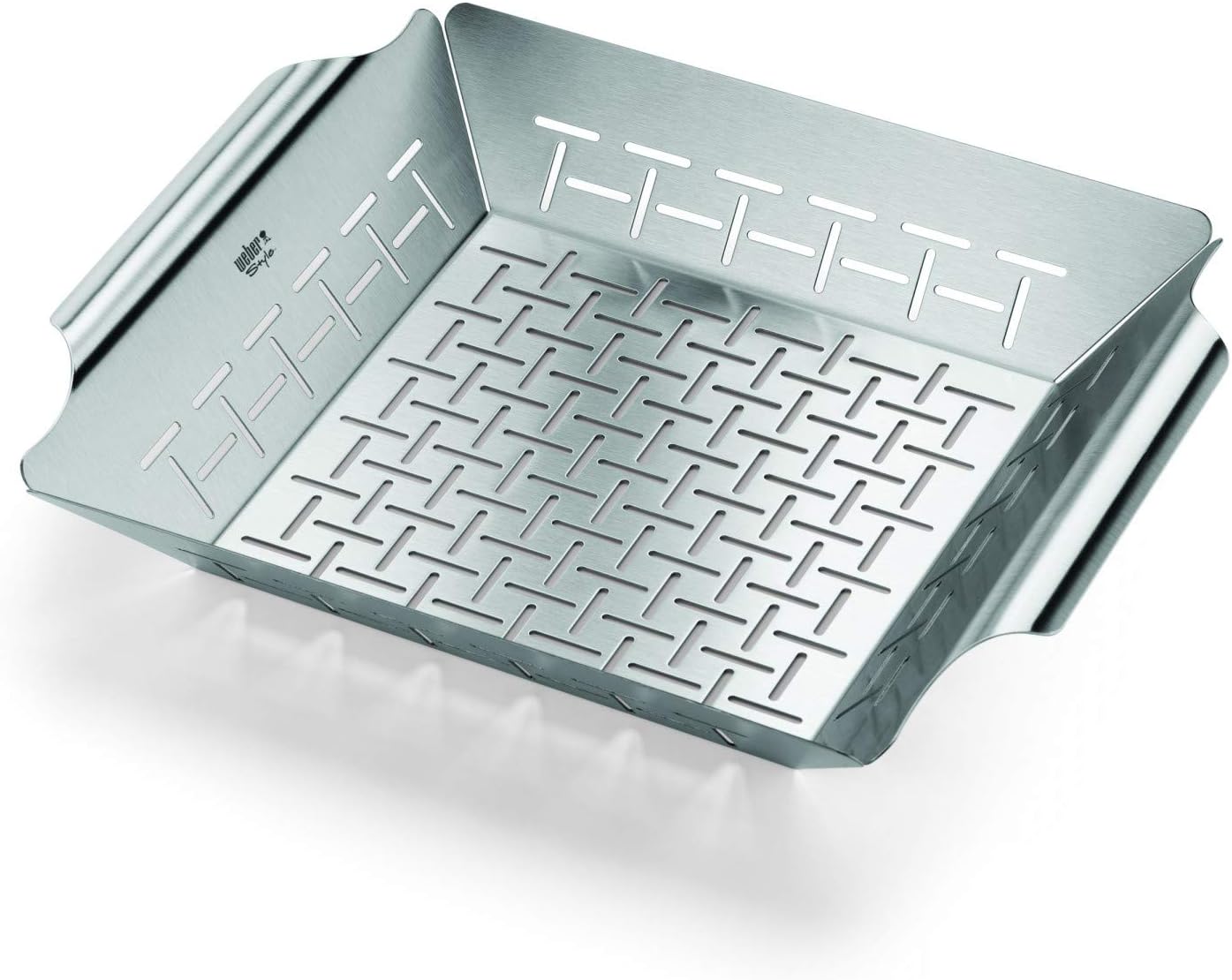
| Weber Deluxe Grilling Basket 🏆 Best Overall | Approximately 11.8" W × 13.8" D × • Stainless steel with no nonstick • Machined openings sized to retain | Buy Now | |
| Cave Tools Vegetable Grill Basket 💰 Best Budget | Roughly 13.8" × 11.9" × 3" — • Stainless steel • Perforated tray with raised edges and | Buy Now | |
| Proud Grill UltraVersatile Stainless Steel Grill Basket 🎯 Best Versatile | Approximately 12" × 7.5" surface with • Detachable four-way handle with • Heavy-gauge stainless steel | Buy Now |


3 Recommended Best Grill Basket for Vegetables
Three research-based candidates compared on features and everyday use
We compared product identity and practical buying criteria from the current Amazon listings. No independent hands-on tests were performed. Confirm the exact variant, dimensions, and care instructions before ordering.
🌟 Key Features That Stand Out
- ✓ Dimensions: Approximately 11.8" W × 13.8" D × 2.5" H — suitable for side-dish quantities.
- ✓ Material: Stainless steel with no nonstick coating that can flake.
- ✓ Slot design: Machined openings sized to retain diced vegetables while permitting airflow.
- ✓ Handles: Integrated loop handles for safe movement.
- ✓ Compatibility: Designed for Weber Q 300/3000 and larger gas grills plus 18" and larger charcoal grills; widely used on other brands as well.
- ✓ Care: Dishwasher-safe according to manufacturer.
- ✓ Capacity may require multiple batches for large groups
💡 Why We Recommend It
🎯 Best For
🌟 Key Features That Stand Out
- ✓ Dimensions: Roughly 13.8" × 11.9" × 3" — competitive capacity for the price.
- ✓ Material: Stainless steel, dishwasher-safe claims.
- ✓ Design: Perforated tray with raised edges and curved handle for transport.
- ✓ Use cases: Vegetables, shrimp, fish pieces, fruit, and other small items.
- ✓ Extras: Often promoted with free recipe resources from the brand.
- ✓ May feel lighter/less reinforced than premium models
- ✓ Long-term warping resistance less documented than thicker options
💡 Why We Recommend It
🎯 Best For
🌟 Key Features That Stand Out
- ✓ Cooking area: Approximately 12" × 7.5" surface with two movable dividers (multiple positioning options).
- ✓ Handle: Detachable four-way handle with rubber grip; removes for lid closure and storage.
- ✓ Material: Heavy-gauge stainless steel, perforated for smoke circulation.
- ✓ Compatibility: Intended for charcoal, gas, pellet, and ceramic grills.
- ✓ Care: Dishwasher-safe claims.
- ✓ Higher price than basic trays
- ✓ Dividers add parts that must be stored or cleaned
💡 Why We Recommend It
🎯 Best For
🏆 Our Top Pick
The best grill basket for vegetables is the one that matches your typical batch size, preferred material, and tolerance for maintenance. For most U.S. home cooks the Weber Deluxe Grilling Basket offers the best research-supported balance of capacity, hole design, lid compatibility, and proven stainless construction. Budget shoppers can start with the Cave Tools model; large-batch cooks should look at a multi-pack set.
Prioritize hole size relative to your usual cuts, a stable base, and materials that fit your cleaning habits. With the right basket, grilled vegetables become a reliable, flavorful side rather than a source of lost food and frustration. Check current dimensions, care instructions, and owner feedback on the product page before purchasing, as listings and manufacturing details can change.
How to Choose the Best Grill Basket for Vegetables
Size and Capacity
Match the basket to your typical batch size and available grate space. A roughly 12 × 12-inch tray suits two to four people; deeper or larger models (or multi-packs) help when feeding six or more. Measure your grill’s cooking area and leave room for the main protein. Oversized baskets can force you to cook in stages or crowd the food, reducing char quality.
Hole or Slot Design
The openings must be smaller than your smallest vegetable pieces. Finely diced onion or broccoli florets need tighter slots or mesh; larger cuts of zucchini or asparagus tolerate wider gaps. Too-large openings defeat the purpose; too-small openings can restrict airflow and produce steaming rather than grilling.
Material and Build Quality
Stainless steel is the most common and lowest-maintenance choice; look for thicker gauge and reinforced corners to resist warping. Cast iron and carbon steel deliver superior searing and heat retention but require seasoning care and thorough drying. Nonstick coatings ease cleanup but can degrade under high heat or with metal tools. Avoid thin, flimsy trays that bend under load or heat.
Handle Design and Lid Clearance
Fixed handles are simple but may prevent full lid closure. Detachable handles solve that problem and improve storage. Loop or dual side handles aid safe lifting of a full, hot basket. Confirm the overall height will fit under your closed lid if you rely on convection cooking.
Stability on the Grates
Flat, wide bases stay put better than rounded or narrow designs. Rolling baskets intentionally move; open trays should not. Check product photos and descriptions for base geometry if stability is a priority.
Ease of Cleaning and Maintenance
Dishwasher-safe stainless is the most convenient. Cast iron and carbon steel need hand washing, drying, and occasional oiling. Nonstick surfaces require non-abrasive care and temperature discipline. Factor ongoing effort into your decision.
Budget and Value
Functional stainless trays start at modest prices; reinforced or feature-rich models (dividers, detachable handles, heavy gauge) cost more. Premium carbon-steel or well-known brand pieces command higher prices justified by tested performance and longevity for frequent users. Buy the simplest durable design that meets your capacity and material preferences rather than the most feature-laden option.
Common Buying Mistakes
Choosing openings that are too large for your usual cuts, buying a basket that cannot fit under the lid, underestimating capacity needs for gatherings, and selecting nonstick without checking maximum temperature ratings are frequent regrets. Also verify actual dimensions against your grill rather than relying solely on “fits most grills” claims.
Other Buying Guides
Shopping for related gear too? Explore our best Grill Mat for Vegetables, best Meat Claws for Pulled Pork and best Grilling Skewers for Kebabs guides.
Practical Tips for Getting the Most From Your Grill Basket
- Preheat the basket briefly on the grill so vegetables start sizzling immediately rather than steaming.
- Oil the food, not just the basket — a light coating of high-smoke-point oil helps browning and reduces sticking on stainless or cast iron.
- Cut pieces uniformly so everything finishes at roughly the same time; denser vegetables (carrots, potatoes) benefit from a head start or par-cooking.
- Do not overcrowd — a single layer or light toss allows better contact with heat and smoke.
- Toss or roll periodically for even color, but avoid constant stirring that can break delicate pieces.
- Use the right heat zone — medium-high for most vegetables; move to a cooler zone if flare-ups occur.
- Clean while warm when safe: warm water and a non-abrasive brush remove residue more easily than cold, dried-on food.
- Store dry — residual moisture can lead to spotting or rust on some steels and is especially important for cast iron and carbon steel.
Stainless Steel vs. Cast Iron vs. Rolling Baskets
Stainless open trays offer the best balance of durability, easy cleaning, and direct heat contact for most users. Cast iron and carbon steel excel at deep browning and heat retention but demand more care. Rolling mesh cylinders prioritize convenience of turning and containment at the expense of flat searing surface. Choose according to whether cleanup simplicity, maximum char, or hands-free operation ranks highest for your cooking style.
What Size Grill Basket Do You Need?
For two people, a compact tray or small rolling basket is usually sufficient. Four people typically need a standard 11–13-inch rectangular basket. Larger households or parties benefit from deeper family-size models or multi-packs so vegetables and other items can finish together. Always leave space on the grates for the main protein and for safe handling.
Is a Premium Grill Basket Worth It?
For occasional use, a well-reviewed mid-priced stainless tray delivers most of the benefit. Frequent grillers who value even browning, longevity, and features such as detachable handles or heavy-gauge construction often find premium or brand-name options worth the difference because they warp less and perform more consistently over years of high-heat exposure.
Common Problems and How to Avoid Them
Food falling through usually means openings are too large for the cut size—dice larger or switch baskets. Sticking is reduced by light oiling and preheating. Warping is minimized by choosing thicker stainless or proper cast-iron care and avoiding extreme thermal shock. Difficulty closing the lid is solved by low-profile or detachable-handle designs.