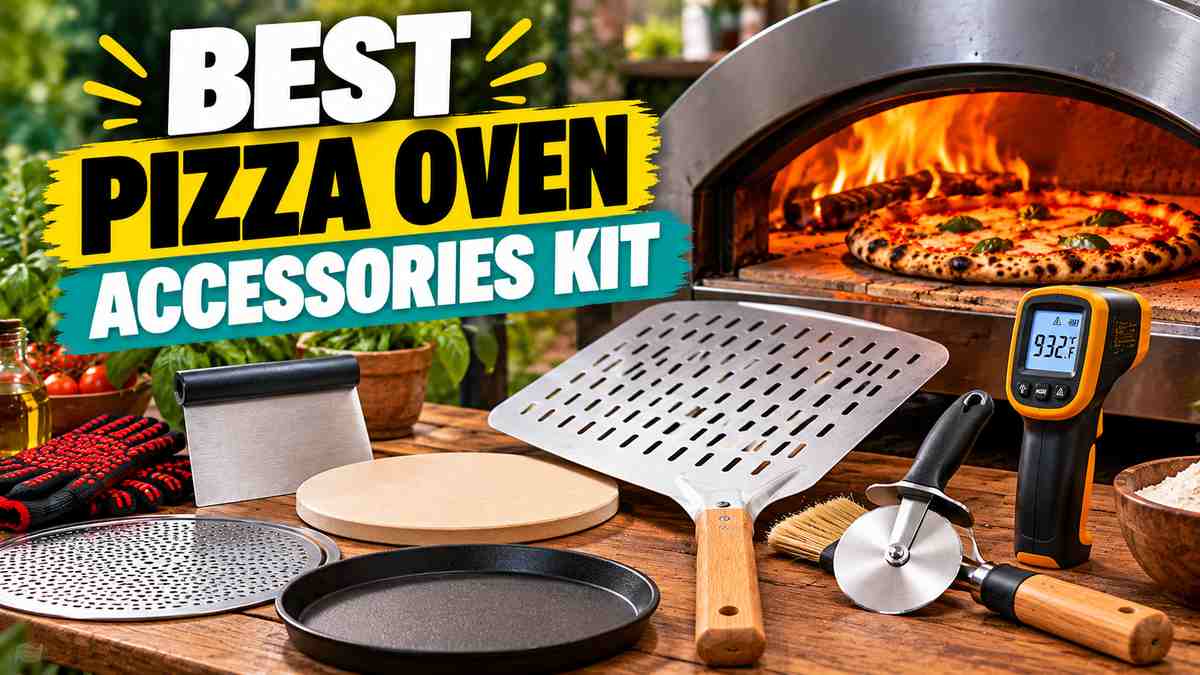
Best Pizza Oven Accessories Kit: 10 Research-Backed Sets and Tools for Better Homemade Pizza
Looking for the best pizza oven accessories kit? This research-based guide compares 10 top-rated Amazon kits and standalone tools — peels, turning peels, infrared thermometers, stones, brushes, and dough boxes — and explains which set fits 12-inch and 16-inch ovens, home ovens, and first-time pizza makers.
Quick Comparison Table
| Image | Product | Key Feature | Buy Now |
|---|---|---|---|
| Yofuly 4PCS Pizza Oven Accessories Kit 🏆 Best Overall Kit | 12-inch perforated launching peel: The perforated blade sheds excess flour before the launch, reducing burnt-flour smoke in hot ovens. | Buy Now | |
| Hans Grill Pizza Stone PRO XL 🏆 Best for Home-Oven Bakers | Rectangular XL baking stone: A rectangular shape spans more of a home oven rack than most round stones, fitting bread loaves as well as pies. | Buy Now | |
| Mooues 12-Inch Aluminum Pizza Peel with Rocker Cutter 💰 Best Budget | 12-inch aluminum launching peel: Lightweight metal slides under dough far more easily than wood, which matters most on your first launches. | Buy Now | |
| Etekcity Infrared Thermometer 774 🏆 Best for Temperature Control | Instant surface readings: Infrared sensing reads the stone or oven floor temperature in under a second, without contact. | Buy Now | |
| Hans Grill 2-in-1 Pizza Oven Brush & Scraper 🏆 Best for Oven and Stone Care | 2-in-1 brush and scraper: Brush debris away and chip hardened spills without swapping tools mid-clean. | Buy Now | |
| Hans Grill Pizza Dough Proofing Box & Tray Kit 🏆 Best for Dough Prep | Lidded proofing trays: Covers prevent skin formation on dough balls during long cold ferments. | Buy Now | |
| Unicook 15 x 12 Inch Rectangular Pizza Stone 💰 Best Value Stone Upgrade | 15 x 12 inch rectangular surface: Fits standard oven racks and grills while leaving clearance for airflow. | Buy Now | |
| 7-Inch Round Aluminum Perforated Pizza Turning Peel 🏆 Best for Neapolitan-Style Bakes | 7-inch round perforated blade: The small round head rotates a pie in place with minimal clearance needed. | Buy Now | |
| Checkered Chef Pizza Cutter Rocker Blade, 14-Inch 👑 Best Rocker Cutter Upgrade | 14-inch stainless steel blade: Full-length edge cuts an entire pie diameter in one rocking pass. | Buy Now | |
| Pizza Oven Cover for BIG HORN-Style Outdoor Ovens 🔥 Best for Oven Protection | Compact-oven fitment: Sized for 12-inch-class portable outdoor ovens of the BIG HORN style. | Buy Now |


Tested & Recommended Amazon Products
Research-based comparisons • No hands-on testing
Research-based buying guide — not a hands-on test. Selections are based on verified Amazon listing data, manufacturer information, and analysis of leading editorial and community sources. See "How We Selected" for details. This article contains affiliate links; we may earn a commission at no extra cost to you. [Affiliate disclosure placement recommended: immediately below the H1.]
🌟 Key Features That Stand Out
- ✓ 12-inch perforated launching peel: The perforated blade sheds excess flour before the launch, reducing burnt-flour smoke in hot ovens.
- ✓ 9-inch round turning peel: A small round blade lets you rotate the pie quickly in a tight oven mouth without knocking toppings.
- ✓ Cleaning brush with built-in scraper: Brush off ash and debris and scrape stuck dough from the stone in one pass.
- ✓ Rocker cutter: A rocking blade cuts clean slices in one motion, better suited to thin, blistered crusts than a wheel cutter.
- ✓ Complete four-tool workflow: Covers launch, turn, clean, and serve without buying pieces separately.
- ✓ Compact-oven sizing: The 12-inch launching blade fits typical 12-inch-class outdoor ovens and standard home-oven stones.
💡 Why We Recommend It
🎯 Best For
🌟 Key Features That Stand Out
- ✓ Rectangular XL baking stone: A rectangular shape spans more of a home oven rack than most round stones, fitting bread loaves as well as pies.
- ✓ Included aluminum peel: Bundles the launching tool, so the stone-and-peel pairing is solved in one box.
- ✓ Stone-first design: Built around heat retention in the baking surface, which is what creates crisp bottom crust in a home oven.
- ✓ Grill-compatible format: Rectangular stones are commonly used on grills as well as inside kitchen ovens, adding a second cooking surface.
- ✓ Recognized brand support: Hans Grill also sells the matching brush and dough boxes in our list, simplifying matching accessories.
💡 Why We Recommend It
🎯 Best For
🌟 Key Features That Stand Out
- ✓ 12-inch aluminum launching peel: Lightweight metal slides under dough far more easily than wood, which matters most on your first launches.
- ✓ Included rocker cutter: One rocking motion cuts slices without dragging toppings the way wheel cutters can.
- ✓ Two-tool focus: Spends the budget on the two highest-use tools instead of padding the count.
- ✓ Aluminum construction: Metal peels handle hot-oven work and thin crusts better than wooden launching peels.
- ✓ Compact storage profile: A single peel plus flat cutter stores in a drawer, unlike bulky multi-piece sets.
💡 Why We Recommend It
🎯 Best For
🌟 Key Features That Stand Out
- ✓ Instant surface readings: Infrared sensing reads the stone or oven floor temperature in under a second, without contact.
- ✓ Laser aiming: A laser pointer shows exactly where you're measuring, so you can map hot and cool zones on the stone.
- ✓ Standalone tool: Works with any oven type — outdoor gas, wood-fired, pellet, or a home oven stone.
- ✓ Community-validated use case: Infrared thermometers are a standard recommendation in established pizza-making communities for oven-floor checks.
- ✓ One-button operation: No app, no probes, no setup — point and read.
💡 Why We Recommend It
🎯 Best For
🌟 Key Features That Stand Out
- ✓ 2-in-1 brush and scraper: Brush debris away and chip hardened spills without swapping tools mid-clean.
- ✓ Stainless steel brush head: Metal bristles dislodge baked-on residue that nylon brushes leave behind.
- ✓ Integrated scraper edge: The scraping blade lifts carbonized dough spots that brushing alone cannot remove.
- ✓ Long-handle format: Keeps hands away from residual oven heat during cleanup between bakes.
- ✓ Compact single-tool footprint: Hangs or stores easily, unlike full-size grill-cleaning rigs.
💡 Why We Recommend It
🎯 Best For
🌟 Key Features That Stand Out
- ✓ Lidded proofing trays: Covers prevent skin formation on dough balls during long cold ferments.
- ✓ Stackable format: Multiple trays organize a full batch of individual dough balls in fridge or counter space.
- ✓ Batch workflow support: Lets you portion one batch into equal balls and track them through multi-day fermentation.
- ✓ Dedicated pizza purpose: Sized and shaped for round dough balls, unlike generic food containers.
- ✓ Pairs with the rest of the pipeline: Complements a stone and peel by improving the input, not the cook.
💡 Why We Recommend It
🎯 Best For
🌟 Key Features That Stand Out
- ✓ 15 x 12 inch rectangular surface: Fits standard oven racks and grills while leaving clearance for airflow.
- ✓ Stone-only value format: Concentrates the budget on the baking surface rather than bundling lesser tools.
- ✓ Grill-compatible: Rated for grill use, enabling high-heat bakes that kitchen ovens can't reach.
- ✓ Moderate 6.8 lb weight: Heavy enough for heat retention, manageable enough to move for cleaning.
- ✓ Rectangular versatility: Doubles as a base for bread, flatbreads, and reheating leftover pizza.
💡 Why We Recommend It
🎯 Best For
🌟 Key Features That Stand Out
- ✓ 7-inch round perforated blade: The small round head rotates a pie in place with minimal clearance needed.
- ✓ Perforated surface: Excess flour falls through before rotation, reducing smoke in hot ovens.
- ✓ Aluminum construction: Light blade weight makes the rapid wrist motion of turning effortless.
- ✓ Metal handle: Stands up to sustained high-heat oven environments better than wood handles.
- ✓ Single-purpose focus: Built exclusively for the rotate step, where precision matters most.
💡 Why We Recommend It
🎯 Best For
🌟 Key Features That Stand Out
- ✓ 14-inch stainless steel blade: Full-length edge cuts an entire pie diameter in one rocking pass.
- ✓ Included blade cover: Safe storage and drawer protection, a small detail many rocker listings omit.
- ✓ Rocker action: Rocking cuts press through crust rather than dragging, preserving topping placement.
- ✓ Dishwasher-friendly stainless format: Stainless steel simplifies cleaning versus wooden-handled alternatives.
- ✓ Specialist brand pedigree: From a kitchenware brand focused on prep tools, with a large review base behind the design.
💡 Why We Recommend It
🎯 Best For
🌟 Key Features That Stand Out
- ✓ Compact-oven fitment: Sized for 12-inch-class portable outdoor ovens of the BIG HORN style.
- ✓ Weather protection: Shields the oven body from rain, dust, and UV exposure between uses.
- ✓ Fitted outdoor format: Designed to stay on a stored oven rather than a generic tarp wrap.
- ✓ Low-cost longevity play: Extends oven lifespan for a fraction of the oven's cost.
- ✓ Model-specific sizing: Model-matched covers fit more securely than one-size alternatives.
💡 Why We Recommend It
🎯 Best For
🏆 Our Top Pick
5. Hans Grill 2-in-1 Pizza Oven Brush & Scraper — Best for Oven and Stone Care
Short description: This dual-purpose tool combines a stainless-bristle brush head with an integrated scraper on a long handle, built for the job most owners postpone: clearing ash, charred flour, and stuck dough off the oven floor and stone. It targets outdoor oven owners who need one durable tool for between-bake cleanup rather than another cooking accessory.
Product information
- Product Name: Hans Grill 2-in-1 Pizza Oven Brush & Scraper
- Brand: Hans Grill
- Model: Not specified in available Amazon data (unverified)
- Amazon ASIN: B08N1GD3HR
- Amazon URL: https://www.amazon.com/dp/B08N1GD3HR
- Best For Badge: Best for Stone Care
- Research Verification Status: Verified via Amazon product data (title, ASIN, brush-plus-scraper composition, stainless steel head). Handle length unverified.
Key features
- 2-in-1 brush and scraper: Brush debris away and chip hardened spills without swapping tools mid-clean.
- Stainless steel brush head: Metal bristles dislodge baked-on residue that nylon brushes leave behind.
- Integrated scraper edge: The scraping blade lifts carbonized dough spots that brushing alone cannot remove.
- Long-handle format: Keeps hands away from residual oven heat during cleanup between bakes.
- Compact single-tool footprint: Hangs or stores easily, unlike full-size grill-cleaning rigs.
Who it's ideal for: This is for outdoor pizza oven and kamado-style grill owners — anyone with a stone floor that accumulates ash, flour, and overflowed cheese. It solves the hygiene problem that quietly degrades pizza quality: debris on the floor scorches, smokes, and transfers burnt flavors to the next crust. It also suits occasional users who want one maintenance tool rather than a cleaning arsenal. Skip it for a home oven with a removable stone — a damp stone rub-down is safer there, and wire brushes on kitchen-counter stones shed bristles where you don't want them.
Why we recommend it: Based on its published specifications, the 2-in-1 design is the right engineering for pizza-oven maintenance specifically: brush-and-scraper combos exist for grill grates, but the scraper edge here is aimed at flat stone floors where dough welds on during long sessions. The editorial case for including a dedicated cleaner in any kit list is simple — stone care is the most neglected task in pizza making, and neglected floors smoke, which beginners misdiagnose as an oven defect. The trade-offs: stainless bristles demand inspection (a loose bristle in food is the known risk category for wire brushes, so check the head and replace it when worn), and it does nothing for the cook itself. Compared with the brush in the Yofuly kit, this is the standalone upgrade for owners who bought tools separately and skipped cleaning entirely.
Pros
- Combines brushing and scraping in one pass
- Stainless head handles baked-on residue
- Long handle keeps hands clear of residual heat
- Addresses the most commonly neglected maintenance task
- From a brand with matching stones and dough boxes
Cons
- Wire bristles require periodic inspection and eventual replacement
- Overkill for a standard home oven with a removable stone
- Does nothing for the cooking process itself
Best For Badge: Best for Stone Care
Editorial verdict: Buy this if you run a wood- or gas-fired outdoor oven and its floor has never had a proper clean. Consider a scraper-only tool if you mostly use a removable home-oven stone.
How to Choose the Best Pizza Oven Accessories Kit
Match the Kit to Your Oven Size First
Oven size is the first filter, because peel and turning-peel dimensions must match your cooking surface. A 12-inch-class oven (Ooni Koda 12, BIG HORN 12, similar compact models) wants a 12-inch launching blade and a 6–8-inch turner; a 16-inch oven wants a 14–16-inch peel, or you'll launch pies that hang off the blade. Home-oven bakers should measure their oven racks and any stone before choosing — a 15 x 12-inch rectangular stone pairs with a peel sized to slide onto it. The commonest mistake is buying a beautiful large peel for a small oven and discovering the blade won't rotate inside the oven mouth. Check your oven's interior dimensions against the peel blade size, not the other way around.
Understand What a Kit Actually Needs to Include
A functionally complete kit covers four jobs: launching (a wide peel), turning (a small round peel for hot ovens), cleaning (a brush or scraper), and serving (a cutter). Temperature measurement — an infrared thermometer — is a fifth job that almost no bundle includes, which is why we list one separately. Evaluate kits by workflow coverage, not piece count: a 2-piece kit that nails launch and slice can beat a 7-piece kit padded with a dough roller and a server you'll never use. Ask of each piece: will I use this every session? If the honest answer is no, the money belongs elsewhere.
Materials: Aluminum, Stainless, Wood, and Stone
launching peels work best in aluminum — light, thin, and slippery enough for dough release under heavy toppings. Stainless steel appears in brushes, cutters, and some peels; it's stiffer and heavier but corrosion-resistant. Wood belongs in prep and serving peels, not launching peels: moisture in the dough sticks to wood and the added drag ruins first launches. For stones, cordierite is the standard material for oven and grill use because it tolerates thermal cycling well; verify the listing states the material rather than assuming it. Handles matter too — metal handles survive oven-adjacent heat, while wooden handles stay cooler to the grip but can loosen or warp near sustained heat.
The turning peel: The Accessory Most Kits Skip
In ovens above roughly 650°F, the bake moves fast enough that the pie must rotate once or twice to char evenly, and the tool for that is a small round turning peel. Kits that omit it force you to improvise with tongs or to drag the whole pie out on the big peel — slow, and a common cause of collapsed crust edges. If your kit lacks a turner and you cook hot, add one; the 7-inch perforated format on this list is the standard. Home-oven bakers at 450–550°F can reasonably skip it.
Temperature Measurement and Why It Matters
Oven dials and open-flame ovens both mislead: the air can read 600°F while the stone floor lags 150 degrees behind, and stone temperature — not air temperature — determines bottom-crust quality. An infrared thermometer closes that gap with an instant surface reading. What to look for: a laser aiming dot so you can map zones, a temperature range comfortably above 900°F for wood-fired use (verify the specific model's range on the listing), and simple one-button operation. Note the limitation: infrared reads surfaces only, so a probe thermometer remains necessary for internal dough temperatures. Position the thermometer as the first add-on to any kit.
Stone Care and Cleaning Reality
Stones and oven floors need dry maintenance: brush or scrape debris, and let the oven's own high heat carbonize and burn off residue over time. Never wash a stone with soap — porous cordierite absorbs it and the flavor reaches your next crust — and never shock a hot stone with cold water, which can crack it. Wire-bristle brushes demand periodic inspection: check for loose bristles and retire the brush when the head thins. Plan the cleaning tool as part of the kit decision, because a stone that's never cleaned eventually smokes every bake.
Build Quality Signals Worth Checking
With specifications often sparse in this category, look for listings that state blade gauge or thickness, handle length, and materials explicitly — vagueness there correlates with thin metal and short handles. Check whether the handle attaches with screws or welds, read review themes about warping or bending rather than counting star totals, and favor brands that publish consistent accessory ecosystems (stones, brushes, boxes that actually fit together). A rocker cutter should include a blade cover; a perforated peel should state hole pattern density. Where a listing withholds basic specs, treat that as information.
Budget, Midrange, and Premium: Where the Money Goes
At budget level, spend on the two unavoidable tools — a metal launching peel and a cutter — and accept their limits. In the midrange, the winning move is usually the complete multi-piece kit plus a standalone infrared thermometer, because that combination covers every job with one gap-filler. At premium level, you're buying brand-matched build quality and finish from specialist manufacturers; the functional difference over a good midrange kit is real but modest, and mostly shows up in handle feel and longevity. The genuine premium mistake is paying flagship prices for tools your oven size doesn't need — a 16-inch peel for a 12-inch oven impresses no one at dinner.
Common Buying Mistakes
Four mistakes account for most accessory-kit regret. First, buying for the wrong oven size — measure before ordering. Second, counting pieces instead of jobs: more tools in the box isn't more capability. Third, skipping the thermometer to save twenty dollars and then guessing at stone readiness for years. Fourth, ignoring the maintenance piece, then wondering why the oven smokes by summer's end. A fifth, subtler error: buying a wooden launching peel because it looks traditional, then fighting stuck dough every session. Wood is for serving; metal is for launching.
Compatibility With Your Specific Oven
Accessory kits are mostly oven-agnostic, with two exceptions. Stones: dedicated outdoor ovens use proprietary stones with specific dimensions — buy brand-matched replacements, not generic rectangles. Covers: fitment is model-specific, and a cover for a different oven model will flap, gap, or not fit at all — verify against the listing's stated fitment and measure your oven. Peels, brushes, thermometers, and dough boxes work across brands. When in doubt, measure the oven mouth, the stone, and the storage shelf, and compare those numbers to the listing before checkout.
Practical Tips for Getting the Most From Your Pizza Oven Accessories
1. Preheat the stone longer than feels reasonable. Give a home-oven stone 45–60 minutes; give an outdoor oven's floor time to saturate with heat before the first launch. Verify with an infrared thermometer rather than trusting the dial or the flame.
2. Flour lightly, then perforate it away. Dust the peel with flour or semolina, place the stretched dough, give it a shake to confirm release — and if your peel is perforated, shake off the excess so it doesn't burn on the stone floor.
3. Launch small and confident. A 10–12-inch dough on a 12-inch blade leaves working margin; an oversized dough folds on launch. Stretch smaller than feels impressive until your technique is consistent.
4. Turn early in hot ovens. In a 700°F+ bake, rotate the pie 20–30 seconds after launch, then every 20 seconds or so. A turning peel makes this a two-second job; tongs make it a topping-scattering one.
5. Clean the floor between sessions, not during. Brush ash and debris when the oven is cool or between bakes with the long-handled brush; scraping mid-bake disturbs the pie you're cooking.
6. Store the stone in the oven. Leaving the stone in a home oven (if the rack tolerates the weight) buffers temperature swings for bread and roasts — and means it's always preheating with the oven.
7. Keep the cover off a hot oven. Wait until the oven is fully cool before fitting any cover; trapping residual heat and moisture under fabric degrades insulation and finish.
8. Retire tools on a schedule. Inspect wire-bristle heads monthly, replace worn covers, and re-tighten screw-on handles. A five-minute check each season keeps every tool on this list performing like new.
Pizza Oven Accessories Kit vs. Buying Tools Separately
A kit wins on cost-per-tool, gifting convenience, and guaranteed size coherence — the peel, turner, and cutter in one bundle are sized for the same oven class. Buying separately wins when you already own any piece of the workflow, when you want brand-matched premium quality on the one or two tools you use most, or when a kit's filler pieces don't serve your style — a Neapolitan-focused baker needs the turner far more than a dough roller. The practical rule: if you own nothing, a complete kit like the Yofuly is the efficient start; if you own a peel, buy the missing jobs (turner, thermometer, brush) individually.
Which Pizza Oven Accessories Are Worth Paying Extra For?
Ranked by results-per-dollar: first, an infrared thermometer, because stone temperature governs crust quality more than any other variable you can't see; second, a proper turning peel if you bake hot — it converts uneven bakes into even ones immediately; third, a perforated launching peel for anyone cooking with flour-dusted dough in a hot oven; fourth, a stone of correct size for your surface. Lower down the list: novelty cutters, dough rollers, and serving accessories — useful, but they don't change what comes out of the oven. Spend where measurement and rotation happen; decorate later.
Final Thoughts: Which Pizza Oven Accessories Kit Should You Buy?
Choose by workflow, not by piece count. For most buyers starting out with a 12-inch-class outdoor oven, the Yofuly 4PCS kit is the best pizza oven accessories kit we verified: it alone covers launch, turn, clean, and slice, and its perforated launching peel plus 9-inch turner fix the two failures that derail beginners. Home-oven bakers without a stone should start with the Hans Grill Pizza Stone PRO XL instead, since stone-plus-peel is the correct first purchase for that setup; and on a strict budget, the Mooues peel-and-cutter pair covers the unavoidable minimum. Whatever you choose, add the Etekcity infrared thermometer — at its price, it is the single highest-impact addition to any setup. The most important consideration isn't the box you buy first; it's matching every tool's size to your actual oven. Measure first, buy the workflow second, and let the tools disappear into better Friday nights.