
Best Silicone Air Fryer Liners for Easy Cleanup
Silicone air fryer liners cut cleanup time and protect your basket — but the wrong size or thickness can leave food soggy. This guide compares seven reusable picks on basket fit, heat rating, thickness, and value, and explains how to match a liner to your Ninja, COSORI, or dual-basket air fryer.
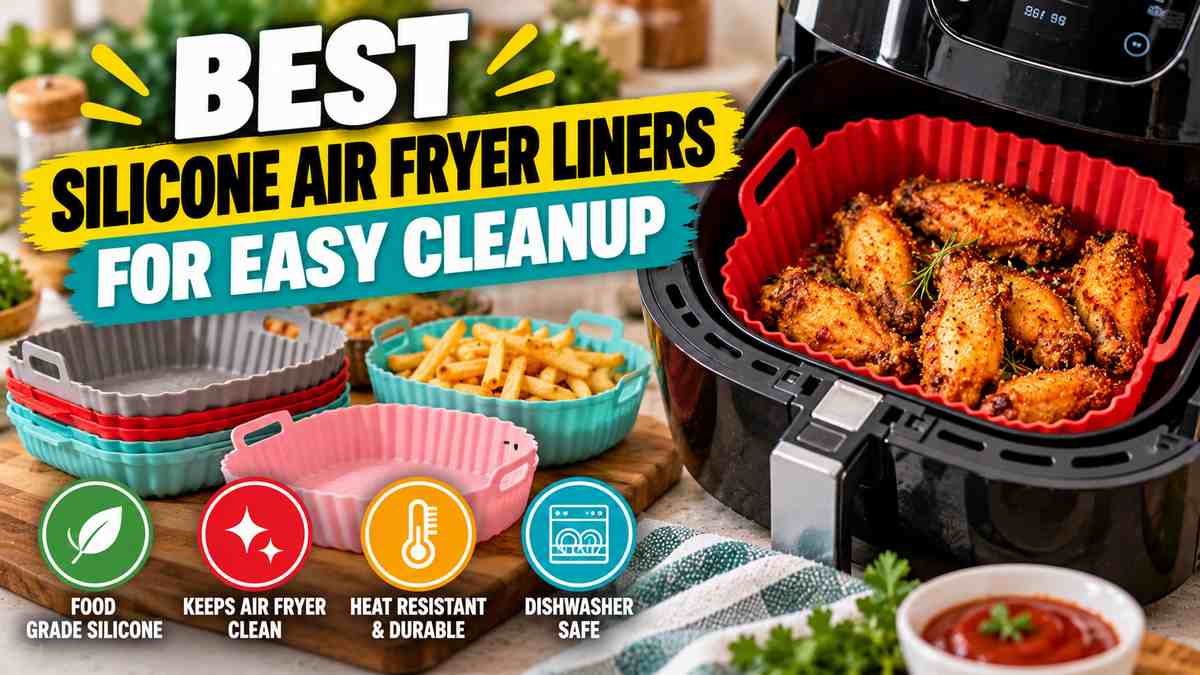
Quick Comparison Table
| Image | Product | Key Feature | Buy Now |
|---|---|---|---|
| PINTAUR Square Silicone Air Fryer Liners (8.5 Inch, 2 Pack) 👌 Best Overall Silicone Air Fryer Liner for Easy Cleanup | 8.5-inch square footprint: Sized for square and rounded-square baskets up to about 8.9 inches across, which covers most 5–6.5-quart models. | Buy Now | |
| Square Silicone Air Fryer Liners (7.1 Inch, 2 Pack) 💰 Best Cheap Silicone Air Fryer Liner | 7.1-inch square size: Sized for compact baskets where the more common 8-inch liners are too large to sit flat. | Buy Now | |
| PINTAUR Silicone Air Fryer Liners for Ninja 8–10 QT Dual Air Fryers 🏆 Best for Dual-Zone Models | Dual-drawer sizing: Roughly 7.87 inches across, matched to the footprint of 8–10-quart two-basket machines rather than the wider single-basket format. | Buy Now | |
| Golden Associate Square Silicone Liners (9 Inch Top / 8 Inch Bottom) 🏆 Best for Big Square Baskets | Tapered 9-inch top / 8-inch bottom profile: The wider rim rests on the basket edge while the narrower base drops in, which is how a liner avoids riding up the walls. | Buy Now | |
| PINTAUR Round Silicone Air Fryer Liners (3 Pack, 4–5.3 QT) 🏆 Best for Round Baskets | Circular shape: Matches round baskets properly, so there are no folded corners and no unused cooking area. | Buy Now | |
| Boribim Square Silicone Air Fryer Liners (8 Inch, 2 Pack) 🏆 Best Thick, Durable Silicone Pot | Stated 450°F / 230°C heat resistance: A confirmed figure, and comfortably above the 350–400°F range most air fryer recipes use. | Buy Now | |
| Buauty Air Fryer Silicone Liners (8 Inch, 3 Pack) 🏆 Best Three-Pack for Continuous Cooking | Three liners per pack: The highest liner count in this guide at a sub-$10 price, which is the core reason to choose it. | Buy Now |


Tested & Recommended Amazon Products
Research-based comparisons • No hands-on testing
Silicone air fryer liners cut cleanup time and protect your basket — but the wrong size or thickness can leave food soggy. This guide compares seven reusable picks on basket fit, heat rating, thickness, and value, and explains how to match a liner to your Ninja, COSORI, or dual-basket air fryer.
🌟 Key Features That Stand Out
- ✓ 8.5-inch square footprint: Sized for square and rounded-square baskets up to about 8.9 inches across, which covers most 5–6.5-quart models.
- ✓ Stated model compatibility: The listing names the Ninja AF141, AF142, and AF181 as well as the COSORI CAF-L501, so you can check your model number before ordering.
- ✓ Ridged, raised base: Grooves lift food off the liner floor and channel rendered fat away from the food, supporting browning rather than steaming.
- ✓ Two liners per pack: One can be in the dishwasher while the other is in the basket, which is what makes an everyday cleanup routine actually work.
- ✓ Integrated side handles: You can lift the liner out without tongs or oven mitts — though the handles do get hot immediately after cooking, so give them a minute.
- ✓ Non-stick food-grade silicone: The listing describes a reusable, non-stick finish that releases breaded foods and sticky glazes without scraping.
- ✓ Deep accessory-market adoption: Ranked #1 in Amazon's Deep Fryer Parts & Accessories category in the snapshot data, with roughly 9,800 ratings at 4.6 stars.
💡 Why We Recommend It
🎯 Best For
✅ Pros
- Explicit 8.5-inch sizing with named compatible models, so fit is checkable before purchase
- Ridged, raised base supports airflow and drainage instead of flat-out blocking it
- Two liners per pack at about $9.99 enables dishwasher rotation
- Very high evidence base — roughly 9,800 ratings at a 4.6 snapshot
- Named a favorite by an independent reviewer testing multiple liner types
- Integrated handles make removal mess-free once the liner cools
❌ Cons
- Maximum heat rating not confirmed in retrieved listing data — verify before high-temperature use
- Solid silicone walls reduce airflow versus perforated liners, so some foods need extra time
- Handles get hot immediately after cooking and need a few minutes to cool
- At 8.5 inches it is too large for dual-basket drawers and too small for 8-quart-plus baskets
🌟 Key Features That Stand Out
- ✓ 7.1-inch square size: Sized for compact baskets where the more common 8-inch liners are too large to sit flat.
- ✓ Stated heat resistance to 464°F: Among the highest figures in this guide, and well above the temperatures most air fryer recipes call for.
- ✓ Food-grade silicone, PVC- and BPA-free claims: The listing describes the material as food-grade with PVC and BPA exclusions — a claim to verify against the packaging when it arrives.
- ✓ Non-stick, scratch- and tear-resistant: Positioned as durable enough for daily use rather than a single-season accessory.
- ✓ Two liners per pack at the lowest price here: The strongest value proposition if your only goal is stopping hand-scrubbing.
- ✓ Multi-appliance use: The listing describes the liner as suitable for air fryer, oven, microwave, and baking use, not just one appliance.
💡 Why We Recommend It
🎯 Best For
✅ Pros
- Lowest price in this guide at $6.88 for a two-pack
- Stated 464°F heat resistance — among the highest claims here
- 7.1-inch size suits compact baskets that larger liners cannot fit
- Claims PVC- and BPA-free food-grade silicone
- Rated for oven, microwave, and baking use in addition to air frying
❌ Cons
- Lowest snapshot rating here at 4.3, suggesting more variable buyer satisfaction
- Brand behind the listing could not be confirmed in retrieved data
- Too small for 6-quart-and-up baskets — grease will escape around the edges
- Material claims (PVC-free, BPA-free) come from the listing and were not independently verified
🌟 Key Features That Stand Out
- ✓ Dual-drawer sizing: Roughly 7.87 inches across, matched to the footprint of 8–10-quart two-basket machines rather than the wider single-basket format.
- ✓ Named compatibility list: The listing specifies Ninja Foodi DZ201, DZ401, and DZ550, plus COSORI, Chefman, and Instant models in the 8–10-quart dual class.
- ✓ Sold as a matched pair: Two liners so both drawers are covered at once — the practical minimum for a dual-zone air fryer.
- ✓ Non-stick silicone finish: Described as reusable and non-stick, which keeps sauces and cheese from baking onto the drawer floor.
- ✓ Dishwasher-oriented care: The listing presents the liners as easy to clean and reusable, the core value proposition of silicone over paper.
- ✓ Same seller and family as our top pick: Shares the PINTAUR brand lineage and the 4.6-star snapshot rating seen across the brand's liner range.
💡 Why We Recommend It
🎯 Best For
✅ Pros
- Purpose-built for dual-drawer footprints rather than adapted from single-basket sizes
- Listing names specific dual-air-fryer models, so compatibility is verifiable
- Matched pair covers both drawers immediately
- Protects a more expensive, harder-to-clean appliance than a simple single basket
- Low price for the amount of cleanup it eliminates
❌ Cons
- Only two liners — no spare while one is being washed
- Narrower footprint covers less of each drawer than a full-size square liner
- Maximum heat rating not confirmed in retrieved listing data
🌟 Key Features That Stand Out
- ✓ Tapered 9-inch top / 8-inch bottom profile: The wider rim rests on the basket edge while the narrower base drops in, which is how a liner avoids riding up the walls.
- ✓ Largest footprint in this guide: Suited to big single-basket air fryers where 8-inch liners leave a ring of exposed basket floor.
- ✓ Non-stick food-grade silicone: The listing describes a non-stick, food-grade, reusable construction aimed at easy food release and cleanup.
- ✓ Multiple size variants under the same brand: The brand also offers 7×7-inch and 8.5×8.5-inch versions, so you can match your basket precisely rather than settling.
- ✓ Two liners per pack: A working pair for a single large basket, enabling rotation.
- ✓ Strong snapshot rating: 4.6 stars across roughly 2,900 ratings, matching the leaders here on satisfaction even with a smaller sample.
- ✓ Baking and roasting versatility: The listing positions the liner for baking-tray use beyond air frying.
💡 Why We Recommend It
🎯 Best For
✅ Pros
- Tapered 9-inch top / 8-inch bottom shape seats properly in large baskets
- Largest footprint in this guide — full coverage for big square baskets
- 4.6-star snapshot rating, matching the category leaders
- Brand offers additional 7-inch and 8.5-inch sizes for other baskets
- Wider rim makes the liner easier to lift out than a flat sheet
❌ Cons
- Highest price in this guide at $12.99 for two liners
- Maximum heat rating not confirmed in retrieved listing data
- Too large for compact, round, or dual-basket air fryers
- Smaller rating pool than the top picks, so evidence is thinner
🌟 Key Features That Stand Out
- ✓ Circular shape: Matches round baskets properly, so there are no folded corners and no unused cooking area.
- ✓ Stated 4–5.3-quart range: Sized for the most popular compact and mid-size round-basket models.
- ✓ Named compatibility: The listing cites Ninja AF101 and AF161, along with COSORI, Tefal, Bear, and Chefman models.
- ✓ Three liners per pack: The most generous count among the single-basket picks here, which extends the gap between wash cycles.
- ✓ Food-grade silicone construction: Described as reusable and non-stick, positioned as a replacement for disposable paper.
- ✓ Compact storage: Round liners nest inside each other, which matters in small kitchens with limited cabinet space.
💡 Why We Recommend It
🎯 Best For
✅ Pros
- Correct circular shape for round baskets — no creased corners or grease channels
- Three liners per pack, the best count-to-price ratio among the single-basket picks
- Names specific compatible models, including the Ninja AF101 and AF161
- Round liners nest for compact storage
- Strong snapshot rating of 4.6 across a large rating pool
❌ Cons
- Only suited to baskets in the 4–5.3-quart range
- Round shape wastes the corners of square or rectangular baskets
- Maximum heat rating not confirmed in retrieved listing data
🌟 Key Features That Stand Out
- ✓ Stated 450°F / 230°C heat resistance: A confirmed figure, and comfortably above the 350–400°F range most air fryer recipes use.
- ✓ Stated 67-mil thickness: Materially thicker than typical liner stock, which supports shape retention and resistance to tearing at the handles.
- ✓ 8-inch square footprint for 4–7 QT: A broad stated capacity band that covers compact through mid-size square baskets.
- ✓ BPA-free food-grade silicone: The listing describes the material as food-grade and BPA-free, dishwasher-safe, and non-deforming.
- ✓ Color-coded two-pack: Supplied as Red + Blue or Black + Brown, which makes it easy to assign one liner per recipe type or per household member.
- ✓ Multi-appliance positioning: Listed as suitable for air fryer, steamer, oven, and microwave use.
- ✓ Large evidence base: Roughly 8,700 ratings at a 4.4 snapshot, with an Amazon's Choice badge on the Red + Blue variant in the retrieved data.
💡 Why We Recommend It
🎯 Best For
✅ Pros
- Confirmed 450°F / 230°C heat rating stated in the listing
- Stated 67-mil thickness supports shape retention and durability
- Broad stated 4–7 QT fit range covers compact to mid-size baskets
- Amazon's Choice badge on the Red + Blue variant in snapshot data
- Color-coded pair makes liner rotation easy to manage
- Roughly 8,700 ratings at 4.4 — a solid evidence base
❌ Cons
- Thicker silicone conducts heat more slowly, which can add cooking time
- Heavier and bulkier to store than thin liners
- Requires scrubbing between the ridges when washed by hand
- Snapshot rating of 4.4 is solid but below the 4.6 leaders in this guide
🌟 Key Features That Stand Out
- ✓ Three liners per pack: The highest liner count in this guide at a sub-$10 price, which is the core reason to choose it.
- ✓ 8-inch square footprint: Fits the majority of square and rounded-square baskets without the overhang of larger liners.
- ✓ Stated 3–6 QT compatibility: A wide band that includes compact and mid-size models from most major brands.
- ✓ Dishwasher-safe claim: The listing states the liners are dishwasher safe, which is the practical test of whether a reusable liner actually saves you time.
- ✓ Heat-resistant food-grade silicone: Described as heat resistant, non-stick, and reusable, positioned as a replacement for disposable parchment.
- ✓ Broad brand compatibility: The listing positions the liner as compatible with most air fryer brands rather than one ecosystem.
💡 Why We Recommend It
🎯 Best For
✅ Pros
- Three liners for $9.98 — the best liner-per-dollar ratio in this guide
- Broad stated 3–6 QT compatibility reduces the risk of a misfit
- Dishwasher-safe claim makes the cleanup promise realistic
- 8-inch size suits the most common basket dimensions
- Amazon's Choice badge in the retrieved snapshot data
❌ Cons
- Specific maximum heat rating not stated in retrieved listing data
- Snapshot rating of 4.4 with roughly 3,800 ratings — a smaller evidence base than the leaders
- 8-inch size leaves gaps in large 8-quart-plus baskets
- Square shape is not ideal for round baskets
🏆 Our Top Pick
How to Choose the Best Silicone Air Fryer Liners
Choosing a liner is mostly a geometry problem with a material question attached. Get the size and shape wrong and no amount of premium silicone will help; get them right and even a cheap liner will do its job for years. Here are the criteria that actually change the buying decision.
Size and Capacity: Match Inches to Your Basket, Not Quarts to Marketing
Liner listings are sold two ways — by quart capacity and by inches — and the two do not map cleanly onto each other. Quart ratings describe the volume of the whole appliance, while inches describe the footprint of the liner, and those are different measurements. Two 6-quart air fryers from different brands can have baskets with noticeably different widths, and a dual-basket 8-quart machine has drawers that are each far narrower than a single 8-quart basket. The practical rule is to measure your basket's interior floor and its opening, then buy a liner whose base is slightly smaller than the floor and whose rim is slightly wider than the opening. Our top pick, the PINTAUR 8.5-inch square liner, is stated to fit square baskets up to about 8.9 inches across in 5–6.5-quart machines, while the Golden Associate liner's 9-inch top and 8-inch bottom are designed for larger baskets. If you cannot measure your basket, prefer a listing that names your specific model — several picks here name Ninja and COSORI model numbers, which is the single most reliable compatibility signal available.
Shape: Round Baskets, Square Baskets, and Dual Drawers
Shape is not cosmetic. A square liner pushed into a round basket creases at the corners, and those creases lift food off the floor, trap steam, and create channels for oil to run underneath — defeating the liner's purpose. Round baskets therefore want round liners such as the PINTAUR three-pack; square and rounded-square baskets want square liners; and dual-basket air fryers want the narrower rectangular format, like the PINTAUR dual-basket pair built around a roughly 7.87-inch footprint. Oven-style air fryers with a flat tray are a separate case entirely: they need a flat mat or a perforated sheet, not a deep pot, because a pot placed on a tray blocks the tray's airflow pattern.
Material and Food-Contact Claims
Every liner here is described as food-grade silicone, and most add "BPA-free." Those phrases are worth understanding rather than trusting at face value. Food-grade silicone is typically made from a polymer called polydimethylsiloxane and is approved by the U.S. Food and Drug Administration for food contact in products such as baking molds, cupcake liners, and storage containers, according to the industry-backed Chemical Safety Facts resource [Chemical Safety Facts](https://www.chemicalsafetyfacts.org/health-and-safety/cooking-with-silicones/). In Europe, LFGB testing is frequently cited as a stricter standard than FDA requirements, and products marketed as LFGB-approved are common in the category [Seed & Sprout](https://seedandsprout.com/pages/lfgb-silicone). What this means for buying: look for a listing that states a standard or a specific heat rating, treat "food safe" without "food grade" as a weaker claim, and remember that a filler-heavy silicone can behave differently from pure silicone. We make no certification claims for any product here — verify claims against the packaging and the manufacturer's documentation.
Thickness and Heat Resistance
Thickness cuts both ways. A thicker liner, such as the Boribim 8-inch pot with its stated 67-mil wall, holds its shape when loaded, resists tearing at the handles, and generally lasts longer. But independent testers at America's Test Kitchen found that thick silicone conducts heat poorly, and that food in thick liners took roughly three to four minutes longer to reach target temperature; their testing preferred liners under about 2 millimeters thick [America's Test Kitchen](https://www.americastestkitchen.com/equipment_reviews/2498-the-best-air-fryer-liners). Heat resistance is the second half of this. Most liners in this category are rated somewhere between 400°F and 464°F, and the confirmed figures we retrieved include 450°F / 230°C for the Boribim liner and a stated 464°F for the 7.1-inch square liner. Typical air frying happens between 350°F and 400°F, so a 450°F rating provides real headroom — but confirm the figure on the listing rather than assuming, because several listings in this guide did not state one at all.
Airflow: The Trade-Off Nobody Mentions Until Food Goes Soggy
An air fryer cooks by circulating hot air, so anything that blocks circulation changes the result. Silicone liners with solid walls catch grease beautifully — that is their whole appeal — but they also reduce airflow, which makes it harder for food to crisp, particularly on the underside [Business Insider](https://www.businessinsider.com/guides/kitchen/best-silicone-air-fryer-liners). Independent guidance is consistent on this point: a liner that blocks airflow produces less crispiness and more uneven cooking [Fritaire](https://fritaire.com/blogs/news/which-air-fryer-liner-works-best). The practical response is not to avoid silicone but to buy the right design for the food. Ridged or raised bases, like the ones on our top pick, lift food off the liner floor and let hot air reach underneath. Perforated silicone liners allow oil drainage and airflow at the cost of letting grease reach the basket. For maximum crispness on breaded food, thin or perforated liners outperform thick solid ones.
Cleaning and Long-Term Maintenance
The entire point of a liner is to reduce the cleaning burden, so evaluate cleaning realistically. Dishwasher-safe is the claim to look for, and most liners here make it. Hand-washing is where the hidden work lives: ridged liners need scrubbing between the grooves, and oil that collects in those channels can bake on if left. Silicone can also hold onto strong odors and stains over time, particularly after cooking fish or heavily spiced food — this is cosmetic rather than a performance failure, and a baking-soda soak generally helps. Budget for a liner as a consumable with a long life rather than a permanent fixture: a two-pack that is used and washed weekly will realistically last a few years before the handles or the non-stick surface degrade.
Safety Considerations
Two safety points are worth taking seriously. First, silicone liners are far safer around a heating element than loose parchment, because they are weighted and do not blow around — but they must still be used as intended, sitting inside the basket rather than propped against the element. Second, if you also use parchment, never place a paper liner in the air fryer without food to weigh it down; the fan can lift an unmoored liner into the heating element, which is a fire hazard, and this is especially relevant on models with a preheat cycle [America's Test Kitchen](https://www.americastestkitchen.com/equipment_reviews/2498-the-best-air-fryer-liners). Finally, liner handles get hot immediately after cooking, as independent testers noted, so give them a minute before lifting [Homes & Gardens](https://www.homesandgardens.com/shopping/best-air-fryer-lines).
Compatibility Beyond the Air Fryer
Many of these liners are also marketed for ovens, microwaves, steamers, and baking. That versatility is genuinely useful if you want one accessory to serve several appliances, and the 7.1-inch liner and the Boribim 8-inch pot both make multi-appliance claims. Check the temperature rating before using a liner in a conventional oven, where temperatures can exceed an air fryer's range, and confirm that the dimensions suit the tray or dish you intend to use. A liner that fits your air fryer perfectly may be far too small for a sheet pan.
Budget and Value
This category is cheap enough that the price difference between the best and worst option is only a few dollars, which reframes the decision. At the low end, the 7.1-inch square two-pack at $6.88 is the cheapest way in. At the top, the Golden Associate pair at $12.99 is the most expensive pick here. The relevant metric is cost per usable liner, not pack price: the Buauty three-pack at $9.98 works out to roughly $3.33 per liner, while two-liner packs at $9.99 work out to about $5 each. When the whole category costs less than a takeout meal, optimize for fit and evidence quality rather than for the lowest sticker price — a misfitting liner is worthless at any price.
Warranty and Support
Accessory purchases at this price point rarely come with meaningful warranties, and none of the listings we reviewed advertised a notable one. What matters instead is the return window: because fit is the main failure mode, buy from a seller whose returns are straightforward and test the liner in your basket on arrival, before you cook with it. If the liner does not seat flat or the handles do not clear the basket rim, return it and size up or down. This is also why buying a listing that names your specific air fryer model is valuable — it converts a potential return into a confident purchase.
Common Buying Mistakes
- Buying by quart rating alone. A "6-quart" liner does not exist in any standardized sense; the inches are what fit, and the quarts are a rough guide.
- Using a single-basket liner in a dual-basket fryer. The drawers are narrower, and a square liner will buckle rather than seat.
- Assuming thicker means better. Thicker silicone lasts longer but cooks more slowly, which is a real trade-off rather than a pure upgrade.
- Ignoring the heat rating. Several listings in this guide do not state one; confirm it if you routinely cook at the top of your air fryer's range.
- Buying only one liner. A single liner reintroduces the wash-between-batches bottleneck the liner was supposed to remove.
- Expecting crisper results than no liner. A solid silicone liner reduces airflow; if maximum crispness is your goal, no liner or a perforated liner will beat it.
Practical Tips for Getting the Most From Silicone Air Fryer Liners
- Measure before you order, then measure again. Take the interior width of your basket floor and the width of the opening. Buy a liner whose base is a little smaller than the floor. This one step prevents most liner returns.
- Buy at least two, ideally three. The convenience comes from rotation, not from a single liner. If you own a dual-basket fryer, buy two packs so both drawers always have a liner while one set is washing.
- Use the ridges as intended. On a ridged liner, spread food out rather than piling it. The grooves exist to lift food and channel fat away; a solid mound of food defeats them and steams the bottom layer.
- Add a few minutes for thick silicone. Independent testing found thick liners can add three to four minutes of cooking time. If your food is pale underneath, extend the cook rather than cranking the temperature, and shake the basket halfway.
- Preheat without the liner. Add the liner when you add the food. This is essential if you ever combine a silicone liner with parchment, and it keeps the liner from sitting empty against a hot element.
- Wash promptly, and soak if needed. Silicone releases most residue easily when washed soon after cooking. If oil has baked into the grooves, soak in warm soapy water or a baking-soda solution before scrubbing.
- Let the handles cool. The handles get hot immediately after cooking and take a couple of minutes to become safely grippable. Keep tongs within reach for the first lift.
- Keep liners for their appliance. Do not assume an air fryer liner is oven-safe at higher temperatures just because it is silicone. Check the stated rating before putting it in a conventional oven or under a broiler, and never use one under a broiler.
Silicone Liners vs. Parchment Paper: Which Should You Buy?
This is the comparison most shoppers actually face, and the answer depends on how often you cook. Parchment liners are disposable, thin, and generally deliver better airflow and crisper results, which is why they are the better tool for breaded foods and baked goods where browning matters. They are also single-use, so a household that air fries daily will go through a box quickly and keep buying. Silicone liners are reusable, dishwasher-friendly, and better at containing saucy, marinated, or greasy food — but their solid walls reduce airflow, which makes crisping harder [Business Insider](https://www.businessinsider.com/guides/kitchen/best-silicone-air-fryer-liners).
If you want one answer: choose silicone for everyday cleanup and saucy or greasy food, and keep parchment on hand for the dishes where crispness is the point. Perforated parchment sits between the two, offering the best airflow of the paper options [Fritaire](https://fritaire.com/blogs/news/which-air-fryer-liner-works-best). The safety rule differs by material, too — a silicone liner stays put, whereas loose parchment can be blown into the heating element if it is not weighted down by food, so never preheat with an empty paper liner in the basket.
Final Thoughts: Which Silicone Air Fryer Liners Should You Buy?
Shopping for the best silicone air fryer liners for easy cleanup comes down to three checks: does it fit your basket, does it have a stated heat rating, and will you own more than one. Size and shape decide everything else — an 8.5-inch square liner for a 5–6.5-quart basket air fryer, a narrower dual-drawer liner for a two-basket machine, a round liner for a round basket, and a tapered 9-inch liner for a large one. Thickness is a genuine trade-off rather than a simple upgrade, because thicker silicone lasts longer but cooks more slowly.
Our overall recommendation is the PINTAUR 8.5-inch square two-pack (ASIN B0DTQ9VFNX) at around $9.99, on the strength of its explicitly stated fit, its named model compatibility, its large rating pool, and independent review coverage that singled out the Pintaur liners for everyday cooking and crisping. If price is the priority, the 7.1-inch square two-pack at $6.88 is the cheapest workable option for a compact basket, and the Buauty three-pack at $9.98 gives you the most liners per dollar. For a distinct need — a dual-basket air fryer — the PINTAUR dual-drawer pair is the pick, because fit beats every other specification. Whatever you choose, confirm the current price and heat rating on the listing before ordering, and treat all figures here as research snapshots rather than live data.


