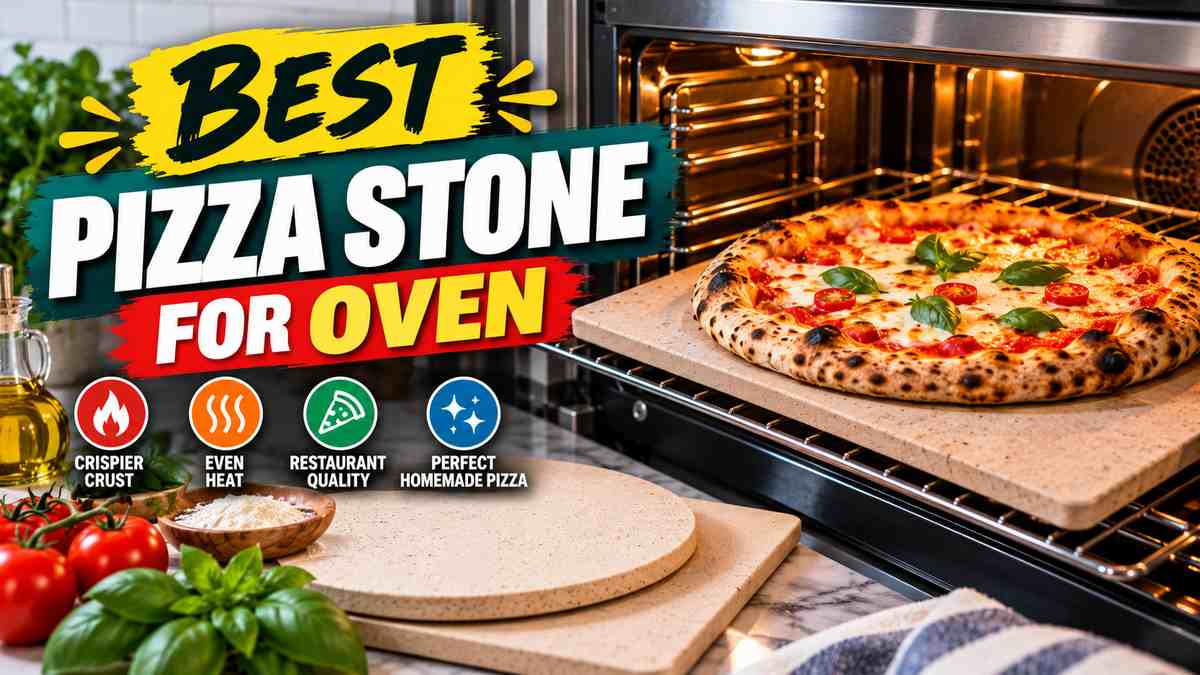
Best Pizza Stone for Oven: 7 Picks for a Crispier, Bolder Crust
Choosing the best pizza stone for oven baking comes down to three things: material, size, and thickness. This guide compares seven cordierite, ceramic, steel, and cast-iron options, explains how heat transfer and oven airflow change your crust, and shows which pick matches your oven, budget, and pizza style. (47 words)
Quick Comparison Table
| Image | Product | Key Feature | Buy Now |
|---|---|---|---|
| Unicook 16-Inch Round Cordierite Pizza Stone 🏆 Best Overall | Cordierite construction: A porous ceramic composite that draws moisture off the dough base, which is what produces a crisp underside instead of a steamed one. | Buy Now | |
| Baking Steel Original 14×16 👑 Best Premium | Solid steel construction: Transfers heat many times more efficiently than ceramic, which is why the base of a pie begins browning on contact. | Buy Now | |
| ThermiChef 16×16 Pizza Steel, 3/8-Inch 🏆 Best for High-Heat Pizza | 3/8-inch steel plate: Substantially thicker than a baking sheet, giving it the thermal mass to hold heat through a second and third pizza. | Buy Now | |
| Old Stone 16-Inch Round Pizza Stone 💰 Best Budget | 16-inch round format: Delivers a full-size baking surface at a budget tier, where many cheap stones shrink to 12 or 13 inches. | Buy Now | |
| Emile Henry Flame Top 14.5-Inch Ceramic Pizza Stone 🏆 Best Ceramic | Glazed ceramic surface: Far less porous than bare cordierite, so it resists the deep staining that marks unglazed stones. | Buy Now | |
| Hans Grill 15×12 Cordierite Pizza Stone with Peel 🏆 Best All-in-One Kit | Cordierite rectangular stone: The tested-default material in a geometry that fits long loaves and batch baking efficiently. | Buy Now | |
| Lodge Pre-Seasoned Cast Iron Pizza Pan 🏆 Best Cast Iron | Pre-seasoned cast iron: Arrives ready to use and improves with use rather than degrading, provided it is dried and lightly oiled. | Buy Now |


Tested & Recommended Amazon Products
Research-based comparisons • No hands-on testing
Most buyers stall on the same three questions: will it fit my oven rack, will it survive the preheat, and is steel really worth the money over stone? The answers are specific, not slogans. Material decides how fast heat enters the dough and whether the underside chars before the top sets. Thickness decides how much heat the surface holds and how long the preheat takes. Size and shape decide whether you can launch a 16-inch pie with a peel, bake two loaves of bread on the same slab, or crowd the airflow your oven needs for even browning.
🌟 Key Features That Stand Out
- ✓ Cordierite construction: A porous ceramic composite that draws moisture off the dough base, which is what produces a crisp underside instead of a steamed one.
- ✓ 16-inch round footprint: Large enough for a full-size pie or a rustic loaf, and round profiles rotate cleanly on a rack to help you reposition the stone.
- ✓ Flat, two-sided baking surface: No raised ridges or molded handles, so you can flip the stone between bakes and still launch pizzas with a peel.
- ✓ Oven and grill rated: The listing supports use in a conventional oven and on a gas or charcoal grill, which extends its usefulness beyond pizza night.
- ✓ Rimless design: A lip-free edge means a peel slides under the crust without catching, reducing torn pies and flour spills.
- ✓ Multi-purpose baking: Works for bread, focaccia, calzones, and reheating leftovers where a dry, conductive surface beats a metal sheet.
💡 Why We Recommend It
🎯 Best For
✅ Pros
- Cordierite material rated best-in-class for even home-oven baking by Serious Eats
- 16-inch round surface fits full-size pies and standard oven racks
- Flat and two-sided, so it flips between bakes and works with a peel
- No seasoning or oiling required — scrape and go
- Usable in the oven and on gas or charcoal grills
❌ Cons
- Porous surface stains permanently from grease and sauce
- Moderate heat transfer — less bottom char than a baking steel
- Ceramic can crack if heated while damp or thermally shocked
- Round shape wastes corner space compared with a rectangle
🌟 Key Features That Stand Out
- ✓ Solid steel construction: Transfers heat many times more efficiently than ceramic, which is why the base of a pie begins browning on contact.
- ✓ Pre-seasoned surface: Arrives ready to use with a protective layer that both prevents sticking and shields against rust.
- ✓ 14 × 16-inch rectangular plate: The rectangle is the versatile geometry — it holds a large pie, two loaves, or a batch of flatbreads.
- ✓ Flameproof and grill-safe: Unlike porous ceramic, steel tolerates direct flame and high heat, so it works on a grill or under a broiler.
- ✓ Dual-purpose griddle: Withstands stovetop-level heat for searing steaks, smash burgers, and griddled sandwiches.
- ✓ Effectively indestructible: No risk of the thermal cracking that eventually ends the life of most ceramic stones.
💡 Why We Recommend It
🎯 Best For
✅ Pros
- Fastest, most intense bottom heat of any surface type
- Rectangular 14 × 16-inch format maximizes usable rack space
- Immune to the thermal-shock cracking that kills ceramic stones
- Flameproof — safe on grills and under broilers
- Doubles as a searing griddle for stovetop cooking
❌ Cons
- Heavy and awkward to move in and out of a hot oven
- Requires thorough drying and oiling to prevent rust
- Too intense for delicate pastries and cookies
- Longer preheat than a thin stone before it is fully saturated
🌟 Key Features That Stand Out
- ✓ 3/8-inch steel plate: Substantially thicker than a baking sheet, giving it the thermal mass to hold heat through a second and third pizza.
- ✓ 16-inch square surface: The largest continuous baking area here — enough for a big pie, several personal pizzas, or a full sheet of flatbread.
- ✓ Disclosed 27.5-pound weight: A concrete indicator of how much stored energy the plate carries into each bake.
- ✓ Dual oven and grill use: Steel tolerates direct flame, so it works on a grill where a ceramic stone should not be risked.
- ✓ High-temperature baking: Suited to 500 F oven pizza and bread baking where fast bottom browning is the goal.
- ✓ Griddle versatility: The same plate can sear, griddle, and bake, replacing several single-purpose pans.
💡 Why We Recommend It
🎯 Best For
✅ Pros
- 3/8-inch thickness holds heat across consecutive bakes
- Largest baking surface here at 16 × 16 inches
- Thickness and weight disclosed, so specs can be compared directly
- Recommended as a lower-cost premium-steel alternative by Serious Eats
- Works as a griddle and grill plate as well as an oven surface
❌ Cons
- About 27.5 lb — genuinely hard to handle safely when hot
- Requires seasoning maintenance to avoid rust
- Needs a longer preheat than a thin ceramic stone
- Oversized for compact ovens and small racks
🌟 Key Features That Stand Out
- ✓ 16-inch round format: Delivers a full-size baking surface at a budget tier, where many cheap stones shrink to 12 or 13 inches.
- ✓ Ceramic stone construction: Absorbs moisture from the dough base, the mechanism that separates a crisp crust from a steamed one.
- ✓ Handle-free profile: With no molded grip or metal rack, a peel can slide across the whole surface without catching.
- ✓ Dual oven and grill use per listing: Broadens the surface's usefulness to outdoor cooking as well as indoor baking.
- ✓ Low-commitment maintenance: Scrape clean, avoid soap, keep it dry — no seasoning routine required.
- ✓ Multi-purpose baking: Handles bread, focaccia, roasted vegetables, and reheating where a dry hot surface beats a metal tray.
💡 Why We Recommend It
🎯 Best For
✅ Pros
- Full 16-inch round surface at a budget price point
- No handles or cage, so it works cleanly with a pizza peel
- No seasoning or oiling routine required
- Same brand family as a Wirecutter budget recommendation
❌ Cons
- Recovers heat more slowly than premium stones between bakes
- Thickness and exact material composition not disclosed — unverified
- Ceramic will crack if heated while damp
- Porous surface stains are permanent
🌟 Key Features That Stand Out
- ✓ Glazed ceramic surface: Far less porous than bare cordierite, so it resists the deep staining that marks unglazed stones.
- ✓ Serving-ready design: Colored, finished ceramic with integrated handles lets you bring the stone from oven to table without re-plating.
- ✓ Integrated side handles: Molded grips make it easier to lift than a handleless slab, though some testers found them less secure than expected.
- ✓ Made in France: Emile Henry's high-fired ceramic is manufactured for thermal stability in home ovens.
- ✓ 14.5-inch round footprint: Fits a standard rack with airflow clearance and accommodates a personal or medium pie, flatbreads, and tarts.
- ✓ Broad baking and serving use: Works for pizza, tarts, roasted vegetables, and warm dips that go straight to the table.
💡 Why We Recommend It
🎯 Best For
✅ Pros
- Glazed surface resists the permanent staining common to bare stones
- Attractive enough to serve from, saving a platter and a transfer
- Wipe-clean compared with the scrape-only care of porous cordierite
- Recognized as a beginner-friendly stone by Bon Appétit
❌ Cons
- Ceramic cracks more readily than cordierite under thermal stress
- Handles reduce usable baking surface and felt precarious in testing
- 14.5-inch round is smaller than the 16-inch alternatives here
- Gentler heat transfer means less aggressive bottom char
🌟 Key Features That Stand Out
- ✓ Cordierite rectangular stone: The tested-default material in a geometry that fits long loaves and batch baking efficiently.
- ✓ Included pizza peel: Provides the launch tool that makes transferring a topped pie onto a hot stone feasible for a beginner.
- ✓ 15 × 12-inch working surface: Sized for a 12–13-inch round pie, a loaf of bread, or a small tray of rolls.
- ✓ Oven and grill compatible: Extends the stone's use to outdoor cooking according to the listing.
- ✓ Fits compact ovens: The shorter 12-inch depth leaves airflow clearance in narrower ovens and toaster-oven-style cavities.
- ✓ Single-purchase convenience: Combines surface and launch tool, avoiding the separate accessory purchase most beginners overlook.
💡 Why We Recommend It
🎯 Best For
✅ Pros
- Includes the peel that beginners most often forget to buy
- Cordierite material matches what major testers rate best for home ovens
- Rectangular shape is more versatile for bread and batch baking
- Shorter 12-inch depth fits compact ovens and tight racks
❌ Cons
- 12-inch depth limits maximum pizza diameter
- Included peel quality not independently verified
- Smaller usable area than a 16-inch round or square stone
- Porous cordierite stains permanently
🌟 Key Features That Stand Out
- ✓ Pre-seasoned cast iron: Arrives ready to use and improves with use rather than degrading, provided it is dried and lightly oiled.
- ✓ Dense thermal mass: Cast iron releases stored heat slowly and continuously, an advantage for deep-dish and pan pizzas.
- ✓ 15-inch round surface: Wide enough for a family-size pie or several smaller ones, with a rim that supports pan-style crusts.
- ✓ PFAS-free cookware surface: A stated non-toxic-coating claim verified from the listing, useful for buyers avoiding chemical nonstick finishes.
- ✓ Multi-technique cooking: Bakes, sears, griddles, and works on the stovetop in addition to the oven.
- ✓ Durability: Cast iron is effectively a lifetime material and can be re-seasoned if the finish wears.
💡 Why We Recommend It
🎯 Best For
✅ Pros
- Superb for deep-dish and pan-style pizza with a supporting rim
- PFAS-free pre-seasoned surface, verified on the listing
- Doubles as a griddle, searing pan, and everyday skillet
- Effectively a lifetime purchase that can be re-seasoned
❌ Cons
- Less bottom char on thin crusts than a baking steel
- Heavy, and the rim makes peel-launching impractical
- Requires drying and oiling to avoid rust
- Maximum oven temperature should be confirmed with the maker
🏆 Our Top Pick
How to Choose the Best Pizza Stone for Your Oven
Most pizza stones in the cordierite and ceramic families perform similarly in a home oven, so the decision is dominated by a handful of factors: material, size and shape, thickness, surface texture, and how you intend to use the surface beyond pizza. The criteria below explain what each one changes, what to look for, and how it maps to a buying decision.
Material: Cordierite, Ceramic, Steel, and Cast Iron
Material determines how quickly heat enters the dough and how forgiving the surface is. Cordierite is a porous, mineral-based ceramic and the material testing outlets treat as the home-oven default; it absorbs moisture from the base and transfers heat moderately, producing an evenly browned crust without scorching delicate baked goods. Glazed ceramic behaves similarly but resists staining and looks better on a table, at the cost of being more crack-prone than cordierite. Steel transfers heat far more aggressively, which is why it produces char and fast oven spring on thin crusts but can blacken buttery pastry. Cast iron sits between them: dense, slow to release stored heat, and ideal for pan-style pizza where the crust needs support as well as heat. Look for cordierite first if you want one versatile surface; choose steel if the crust bottom is your priority; choose cast iron or glazed ceramic for pan pizza and serving.
Size and Shape: Fitting the Stone to Your Oven
Buy as large a baking surface as your oven can accommodate while leaving clearance, because every inch of usable area translates into larger pies and better batch baking. Wirecutter recommends roughly an inch of airflow around the stone on all sides; without it, heat circulation becomes uneven and browning suffers. A 16-inch round or square is the practical target for a standard 30-inch oven. Shape is a second decision: a rectangle holds a large pie, two baguettes, or a tray of rolls more efficiently, while a round aligns better with round pizzas and is easier to reposition. Skip stones sized for personal pies if your aim is a full-size pizza — a 12-inch surface caps your effort at a small pie. Also confirm the depth, not just the width, so the stone clears your oven door and racks.
Thickness and Thermal Mass
Thickness is the best proxy for how much heat a surface holds and how it performs on a second and third bake. Wirecutter identifies a sweet spot: about 0.5 to 0.75 inch for a stone and 0.375 inch for a steel. Too thin and the surface sheds heat the moment a room-temperature dough lands on it, leaving a pale base; too thick and preheat times balloon without proportionate benefit. Disclosed thickness is a genuine buying advantage because it lets you compare products quantitatively instead of inferring from weight or photos. If a listing hides its thickness, treat that as a signal to look at weight instead — a heavier slab generally means more stored heat. For a baker who makes one pizza at a time, mid-range thickness is entirely sufficient; for back-to-back baking, thicker is materially better.
Surface Texture: Why Craggy Beats Smooth
Counterintuitively, a rougher baking surface often produces a better crust. Wirecutter found that pizzas baked on coarser, craggier stones were noticeably browner, crisper, and puffier than those baked on smooth or glazed surfaces, because the texture creates pathways for steam to escape instead of trapping it against the dough. That has a direct buying implication: heavily glazed or polished surfaces look premium but can underperform on crust development, while a slightly rough, matte surface is a feature rather than a flaw. Texture also affects launch. A very smooth surface can let dough slide more easily, but a rough one grips flour better, which many bakers find more predictable when transferring a topped pie. Priorities differ for pan pizza, where the pan's wall does the work and surface texture matters far less.
Heat Retention and Recovery
Heat recovery — how fast a surface returns to baking temperature after a cold dough lands on it — is what separates a good first pizza from a good fourth. Wirecutter's budget pick was described as recovering heat more slowly than its premium stone, a limitation you only notice on consecutive bakes. Steels excel here because steel's conductivity and mass let them dump a large amount of energy quickly, and their faster bake also means less time for heat to drain. To judge this before buying, weight thickness and stated weight together: a heavier surface, whether stone or steel, recovers better. If you routinely bake two or more pizzas per session, prioritize recovery over maximum size, since a slightly smaller surface that stays hot beats a large one that goes cold.
Ease of Use, Handling, and Storage
The best surface is the one you will actually use, and handling is the most underestimated factor. A 27.5-pound steel is a two-handed job with oven mitts; a light stone can be moved with one. Handles are a false friend: Serious Eats found that protruding handles blocked pizza launches with a peel and crowded loaves, and that molded grips can feel precarious. A flat, two-sided surface with no ridges is the more usable design, since it can be flipped between bakes. Storage matters too. Many owners simply leave the stone or steel on an oven rack permanently as thermal ballast, which does lengthen preheat times. ATK's advice is worth following: remove the stone or steel when baking delicate items such as cookies and cakes, because it disrupts the oven's heat-circulation pattern.
Safety and Thermal Shock
Ceramic stones fail for predictable reasons, and every one is avoidable. Thermal shock — cracking caused by rapid temperature change — is the main risk, and the most common trigger is heating a stone that is still damp, since trapped moisture expands and splits the ceramic. Let a wet stone air-dry completely before it goes into a hot oven. Never place a stone or steel directly on the oven floor, because many ovens have vents there that must remain unobstructed for safety. Keep roughly an inch of air around the surface so heat can circulate. When baking delicate items, remove the surface rather than leaving it in place. For steel, add the standard carbon steel cautions: dry it thoroughly and oil lightly to prevent rust, and use a stiff brush with hot water rather than soap. Any certification or temperature-limit claim should be verified against the manufacturer's documentation rather than assumed.
Maintenance, Cleaning, and Long-Term Care
Maintenance differs sharply by material, and it is worth choosing the routine you will actually keep. Unglazed cordierite should never be washed with soap, because the detergent soaks into the pores and lingers; scrape off food and char instead, and accept that stains are permanent. Glazed ceramic wipes clean and stays presentable, which is its main advantage. Steel is treated like cast iron: hot water, no soap, a stiff brush, thorough drying, and a light oil coat. Cast iron follows the same seasoning logic and can be re-seasoned indefinitely if the finish degrades. Regular use actually helps a seasoned surface. The one universal rule is drying: moisture plus heat is what breaks stones, and moisture plus air is what rusts steel.
Budget, Value, and What Warranty to Check
Value here is not about the lowest sticker price but about how much of your baking your surface covers. A budget cordierite stone handles a weekly pizza and a loaf competently; a mid-range cordierite from a tested brand adds undisclosed-to-disclosed specifications, better heat recovery, and more consistent flatness. Steels cost more and ask for seasoning and handling care, but they rarely crack and effectively last indefinitely, which can make them cheaper over years. Cast iron and glazed ceramic buy versatility and presentation instead of raw crust performance. When comparing, read the warranty terms rather than the badge: check what period is covered, whether cracks from normal oven use are included, what shipping costs fall to you, and how to file a claim. Also confirm the stated maximum temperature against your oven's hottest setting before you buy.
Practical Tips for Getting the Most From Your Pizza Stone
- Preheat long — and understand why. A stone or steel only works once it is fully saturated with heat, not merely hot to the touch. Give it at least 45 to 60 minutes at your oven's maximum setting, and remember that a thick surface needs the longer end of that range. An infrared thermometer reading of the stone's surface is a more reliable signal than the oven thermostat.
- Put the surface where the heat is. Position the stone or steel on a rack in the lower third of the oven, not on the floor, and leave about an inch of clearance on all sides so air can circulate. Blocking the vents in the oven floor is a safety issue, not just a performance one.
- Launch with a peel and a dusting of flour or semolina. The single biggest cause of ruined stone-baked pizza is failing to transfer the topped dough onto the hot surface. Build the pizza on the peel, dust it lightly with flour, semolina, or cornmeal, and slide it on in one confident motion. A peel is the one accessory worth buying with your first stone.
- Never heat a wet stone. Moisture trapped in cordierite or ceramic expands on heating and cracks the slab. If the stone gets soaked, let it air-dry fully before it goes back in the oven. This one habit prevents most stone failures.
- Skip soap, and clean by scraping. Unglazed stones should not be washed with detergent — it soaks into the pores. Once the stone is cool, scrape off baked-on food with a bench scraper and wipe with a dry cloth. Permanent stains are cosmetic and do not affect baking.
- Leave it in place, but not always. Keeping the stone or steel on a rack makes it a permanent thermal ballast that improves oven stability, though it lengthens preheat time. When baking cookies, cakes, or other delicate items, take it out so it does not interfere with heat circulation.
- Dry, oil, and store steel and cast iron properly. After any washing, dry the surface immediately on the stovetop or with a towel, then apply a thin film of oil. Rust is the only thing that will meaningfully shorten the life of a steel, and it is entirely preventable.
- Use a bench scraper and let the surface do the work. Avoid metal spatulas and aggressive scrubbing on ceramic. For stuck residue, warm the stone briefly and scrape while it is still warm but no longer hot. Patience with cleanup protects the surface for years.
Final Thoughts: Which Pizza Stone Should You Buy?
The decision narrows to a short list once you stop shopping on brand and start shopping on material and fit. Buy a cordierite stone if you want one versatile, low-maintenance surface for pizza, bread, and pastry — our top recommendation, the Unicook 16-inch round, is cordierite, 16 inches wide, flat and two-sided, and it satisfies the criteria that independent testing identifies as decisive. If budget is the constraint, the Old Stone 16-inch round gives you the same working size with slower heat recovery between bakes, which matters only on marathon pizza nights. If thin-crust char is the whole point, step up to a baking steel; the Baking Steel Original is the premium, seasoned option, while the ThermiChef 3/8-inch plate offers the most thermal mass and the largest surface. For pan and deep-dish pizza, the Lodge cast iron pan is the better tool, since its rim supports the crust and it doubles as everyday cookware. The single most important consideration is not the brand on the box but whether the surface is fully preheated, dimensioned to leave airflow clearance in your oven, and cared for in the one way its material demands: keep ceramic dry, keep steel oiled. Buy for the pizza you actually bake, and any of these surfaces will outperform a metal tray. For most households looking for the best pizza stone for a modest home oven, the cordierite round remains the smartest first purchase.